Banpresto Chikorita Hexagon Eraser — Pokemon Gen II Arcade Prize Item

What This Item Is and Where It Comes From
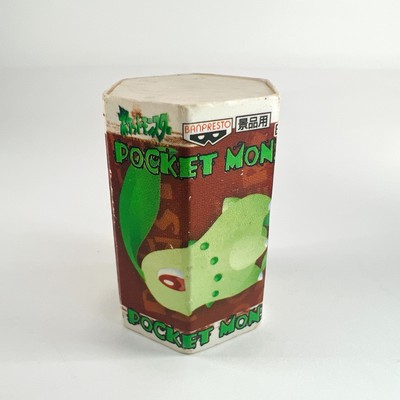
This is a soft-rubber eraser cast in a hexagonal column shape, with Chikorita’s illustration and the text “POCKET MON” repeating across all six outer faces. The top face bears the Banpresto logo alongside the Japanese text keihin-yo — literally “for prize use.” That marking is not decorative: it is an official designation confirming that the item was manufactured exclusively for Japan’s arcade prize distribution channel and was never sold at retail.
The “POCKET MON” abbreviation was a shorthand used on Japanese Pokemon merchandise of the late 1990s and early 2000s, before the single “Pokemon” branding unified globally. The visual design and printing style are consistent with that period, and the estimated production window is approximately 1999 to 2003 — though no exact manufacturing date can be confirmed.
Chikorita and the Generation II Pokemon Boom
Chikorita (No. 152) is the Grass-type starter of Pokemon’s second generation, introduced with Pokemon Gold and Silver, which launched in Japan in November 1999. It is one of three starters available at the beginning of those games — alongside the Fire-type Cyndaquil and the Water-type Totodile. Chikorita’s design is a compact, pale-green creature with a large leaf sprouting from its head, evoking a small herbivorous dinosaur. It evolves into Bayleef and then Meganium.
In the main series games, players who chose Chikorita faced a notoriously difficult early run, since most of the first several gym leaders use types that resist Grass attacks. Despite that, Chikorita became one of the most recognized starters of its generation, helped along by prominent appearances in the anime. For many fans, Generation II represents the peak of the original Pokemon era — Gold and Silver introduced 100 new Pokemon, a new region, a real-time clock, and a post-game return to Kanto. Merchandise from this specific period carries strong nostalgia for the players who grew up with it.
Banpresto, Crane Games, and Why These Items Rarely Left Japan
Banpresto was founded in 1986 as a subsidiary of Bandai and grew into one of Japan’s largest producers of arcade prize goods — the merchandise stocked inside UFO Catcher crane machines found in game centers across the country. Items carrying the keihin-yo label were purpose-built for that system: a player paid to operate the crane, and winning was the only legitimate way to obtain the prize. There was no direct purchase option.
That distribution model is precisely why so few of these items reached buyers outside Japan at the time. They didn’t pass through retail or standard export channels; they circulated entirely within the domestic arcade ecosystem. Banpresto was eventually integrated into Bandai Spirits in 2019, though the Banpresto name continues on the prize goods line today.
The hexagonal shape itself is an uncommon choice for character merchandise and gives the eraser a visual presence distinct from flat or simple-form items of the same era. After roughly two to two-and-a-half decades, the printing and overall design remain intact as a straightforward artifact of Japanese pop-culture manufacturing from the late 1990s and early 2000s.


Shipped directly from Japan by a small shop
$14.07
Ships worldwide from Japan • Full photos and details on the listing