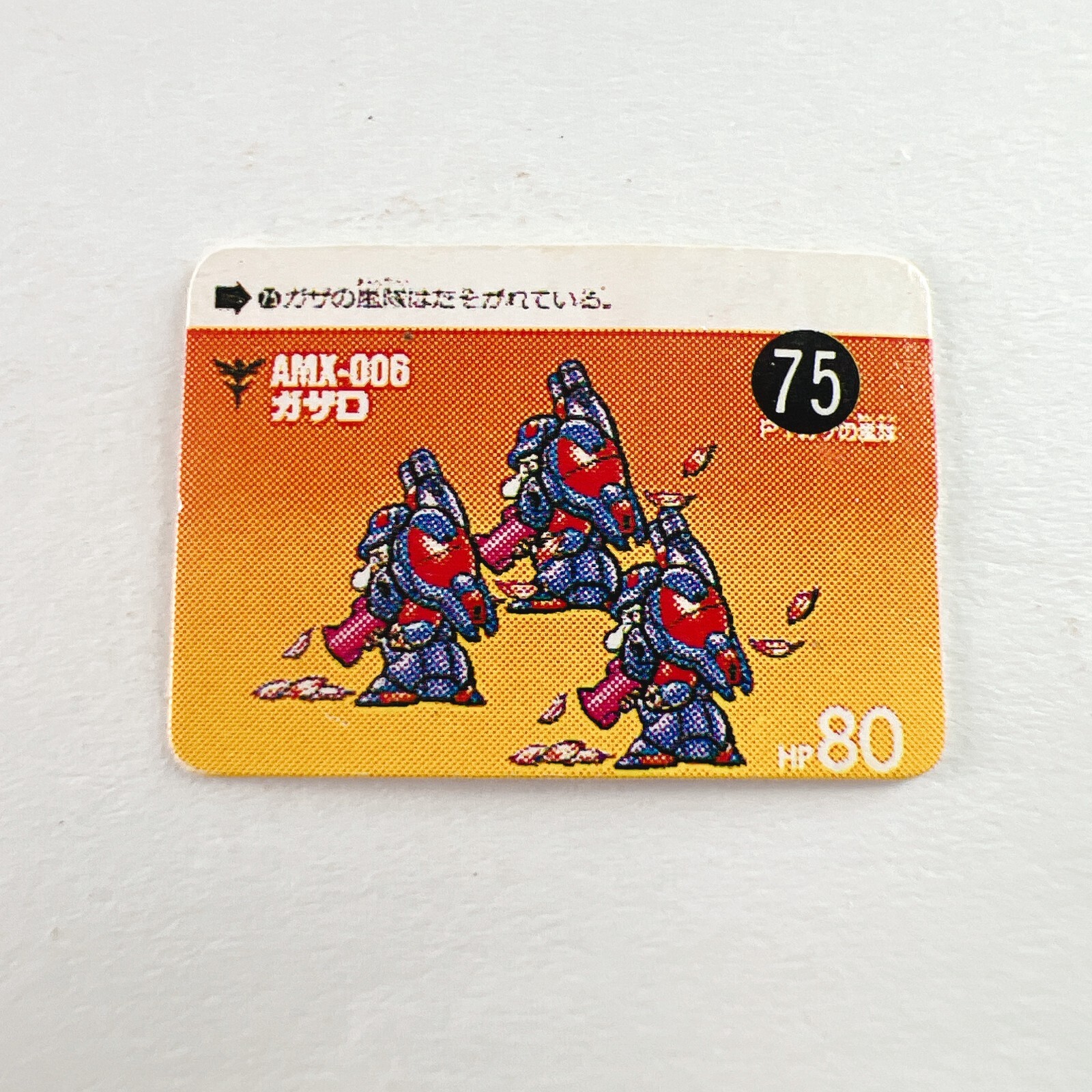
AMX-006 Gazaro Mini Carddas, Comic BonBon 1989

A Game-Stats Card From the Carddas Vending System
This card belongs to the Mini Carddas line — a small-format variant within Bandai’s Carddas trading card system. Standard Carddas cards were dispensed one at a time from coin-operated machines installed in toy stores, convenience stores, and candy shops across Japan; the mini format operated within the same infrastructure but at a reduced card size with distinctive rounded corners. Beyond its artwork, the card carries printed game statistics — including an HP value — that gave collectors a gameplay dimension alongside the visual appeal. A white band running along the top edge contains flavor text adding lore connected to Gazaro within the SD Gundam world.
Its connection to Comic BonBon — the Kodansha manga magazine (1981–2007) and the primary publication home for SD Gundam manga — was most likely through a supplement or promotional tie-in with that magazine, though it may equally have been a standard Carddas vending machine release; the exact distribution format is not confirmed. What is not in doubt is that Comic BonBon’s readership and the Carddas collector audience were, for all practical purposes, the same community of Japanese school-age kids.
Gazaro, Neo Zeon, and the SD Gundam Universe
AMX-006 Gazaro is a Neo Zeon mobile suit. The model designation AMX-006 most closely corresponds to the Gaza-C, a mass-produced unit that appeared in Mobile Suit Zeta Gundam (1985–86) and Mobile Suit Gundam ZZ (1986–87), where it served as Neo Zeon’s standard frontline machine. Neo Zeon is the successor faction to the original Principality of Zeon — the antagonist force of the Universal Century Gundam timeline and one of the most recognizable fictional factions in anime history.
In the SD Gundam universe — where mobile suits are reimagined as individual characters with their own names and personalities — “Gazaro” may carry a distinct character identity rather than functioning as a direct stand-in for the Gaza-C. The two are almost certainly related, but SD Gundam’s framework makes the connection a matter of interpretation rather than a strict equivalence.
The card’s artwork depicts three figures rendered in blue and red, armed with pink weapons, in a pixel-art-influenced style characteristic of Carddas illustration from this period. The stylized Zeon crest at the bottom of the card is unmistakable — a visual shorthand that Gundam fans around the world have recognized for decades.
When Carddas and Neo Zeon Both Hit Their Stride
Bandai launched the Carddas system in 1988, and SD Gundam was among its earliest and most prominent subjects. Cards were priced at roughly 25 to 30 yen each, dispensed randomly from the machine, which encouraged repeat purchasing to complete sets. That structure helped turn Carddas into something close to a social phenomenon among Japanese elementary and middle school students within just a couple of years.
By 1989, Neo Zeon was also at a cultural high point. Mobile Suit Gundam ZZ had concluded in 1987, and the theatrical film Char’s Counterattack — built around Char Aznable’s final Neo Zeon campaign — had premiered in 1988. The Zeon and Neo Zeon side of the Gundam universe has always attracted particular enthusiasm within the fandom; the faction’s aesthetic and its mobile suit designs have a dedicated following that extends well beyond Japan. A card stamped with the Zeon crest and featuring a Neo Zeon unit designation connects directly to that tradition, issued at the moment when both the franchise and the collecting format were at their most energetic.


Comes straight from Japan — no middleman
$8.82
Ships internationally • More photos on the eBay listing