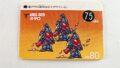
SD Gundam Z II Playing Card from Comic BomBom, February 1990

A Bonus Card from the Height of the SD Gundam Boom
This is a standard playing card — the 2 of Clubs — bundled as a bonus item with the February 1990 issue of Comic BomBom, the monthly boys’ manga magazine published by Kodansha. The front face carries a full-color illustration of Z II in the SD Gundam style, with the character’s name rendered in both Japanese and Roman lettering. Whether this card circulated as a standalone piece or as part of a larger set cannot be determined from the listing alone.
Comic BomBom, which launched in 1981, was one of the primary media platforms for the SD Gundam phenomenon. Bandai, the holder of Gundam’s character licensing rights, worked closely with the publisher to produce tie-in bonuses that gave readers a concrete reason to buy the physical magazine each month. By 1990, this collaboration was well established: the SD Gundam franchise had grown from its origins as Bandai capsule toys (gashapon, beginning around 1985) into BB Senshi plastic model kits, animated OVAs, and multiple running manga series. The card arrived at exactly the peak of that expansion.
The Z II: A Mech from Zeta Gundam’s Extended Universe
The mobile suit depicted on the card is the Z II (MSZ-008), a variable mobile suit that appears in the design documents and side materials associated with Mobile Suit Zeta Gundam, the Sunrise television series that aired in Japan from 1985 to 1986. The Z II was conceived as a simplified, mass-production-oriented derivative of the Zeta Gundam (MSZ-006). It had almost no on-screen time in the main series, but remains a recognized design among fans who explore the Universal Century’s supplementary settings in depth.
In SD form, the Z II’s complex mechanical frame is redrawn in the Super Deformed style: proportions shift toward a large, rounded head and compact body, and the technical details — including the transformation features and primary armament — are reduced to readable shorthand. This approach was consistent with how SD Gundam artists handled nearly every mobile suit in the lineup, translating hard-edged mechanical designs into something immediately accessible and expressive.
Furoku, Magazines, and Japan’s Bonus Item Culture
In Japanese publishing, supplementary items bound into a magazine issue are called furoku. These bonuses — which ranged from cards and stickers to mini plastic models and small figures — were a long-standing method for children’s publishers to encourage regular readership. Because they were sold only through the magazine itself, furoku pieces never entered conventional retail channels. Comic BomBom had no overseas distribution at the time, so items like this card were available exclusively to Japanese readers who purchased the February 1990 issue in person.
Gundam fans outside Japan, particularly those drawn to Zeta Gundam and the broader Universal Century timeline, often seek out material from this period as tangible artifacts of the franchise’s formative commercial era — a time when the SD aesthetic was introducing an entirely new generation of children to the Gundam universe through an unexpectedly playful visual language.


Listed in our eBay store and sent from Japan
$8.82
International shipping available • Ask us anything before you buy