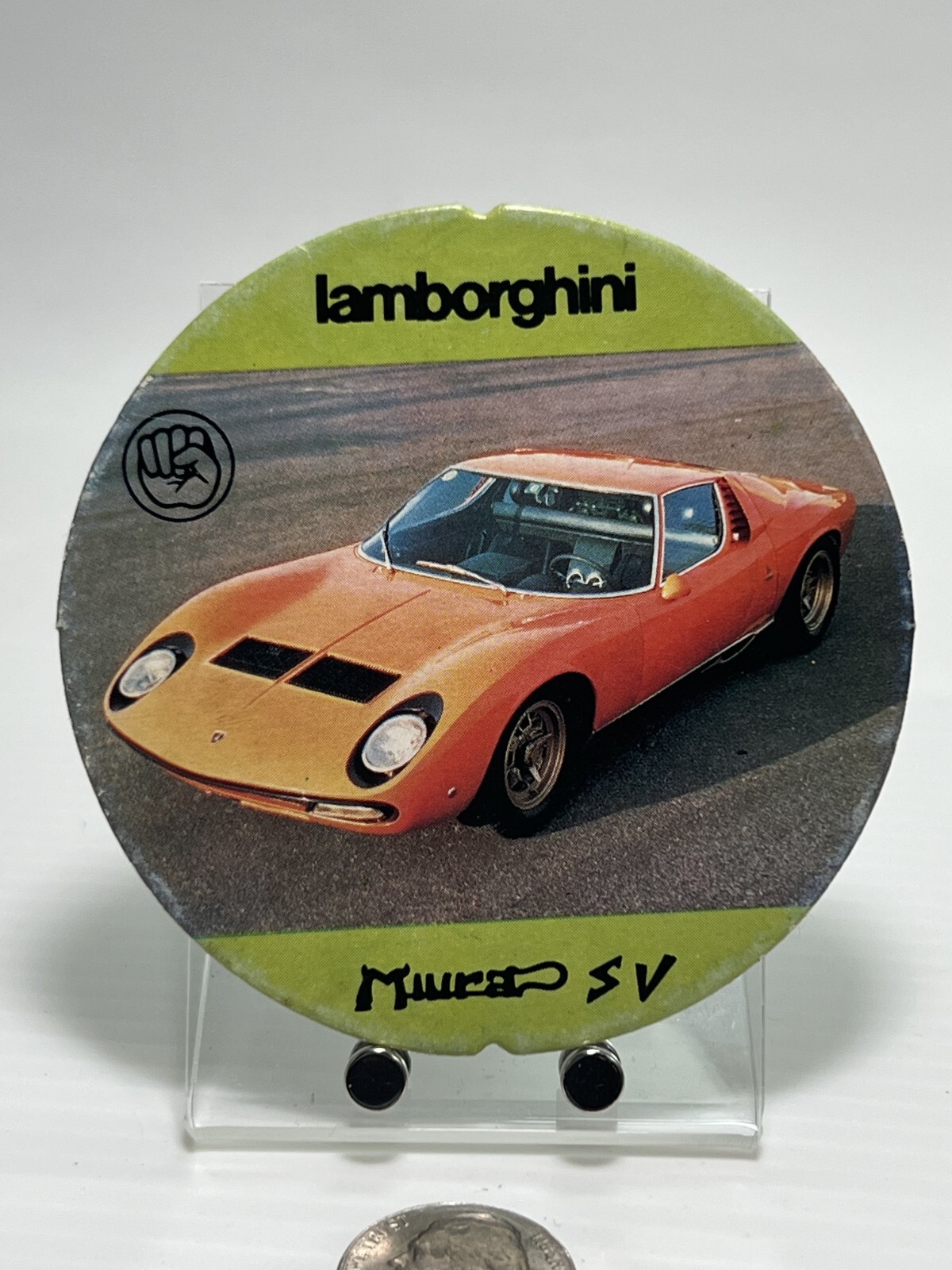
Lamborghini Miura SV Menko Card from Japan's Showa Era

A Traditional Japanese Toy Card Meets an Italian Icon
Menko are traditional Japanese paper toy cards with roots reaching back to the Edo period. Played by children across Japan through the Meiji and Showa eras, the game is straightforward: players take turns slamming their card onto an opponent’s card laid on the ground, trying to flip it and claim it. The cards themselves were inexpensive and mass-produced — sold at candy shops known as dagashi-ya and toy stores, either bundled with snacks or priced individually for pocket money.
This card is a maru-menko, meaning it is circular rather than rectangular. The round format is associated with the earlier Showa period; rectangular cards became more prevalent as the decades progressed, though the round shape persisted as a traditional form. The front carries a full-color photograph of an orange Lamborghini Miura SV, bordered above and below by bold green bands. A small circular logo bearing a fist silhouette appears in the upper left — almost certainly a manufacturer or series mark, but the specific company behind it has not been conclusively identified. Many Showa-era menko producers were small printing and toy outfits whose names and records have not survived intact.
The Car on the Card — and the Boom That Put It There
The Lamborghini Miura made its public debut at the 1966 Geneva Motor Show, designed by Marcello Gandini of the Bertone studio. It is widely recognized as the world’s first mass-produced mid-engine supercar and set the visual and mechanical template that shaped performance car design for generations. The Miura SV — standing for Super Veloce — was the final and most refined variant, introduced in 1971 with higher engine output, revised fender contours, and a larger rear window. Production figures vary by source, but approximately 150 examples were built, making it the rarest configuration in the Miura family.
In Japan, the early-to-mid 1970s saw a cultural wave now remembered as the Supercar Boom. European performance cars — Lamborghinis, Ferraris, Porsches — dominated magazine spreads and television specials, becoming objects of intense fascination for an entire generation. Since owning an actual supercar was far out of reach, menko cards, die-cast miniatures, and plastic model kits served as a kind of stand-in. The Miura SV’s production years of 1971 to 1973 place this card in the early period of that boom, capturing the moment when the car was still a current model and Japan’s appetite for supercar imagery was just beginning to peak.
What Draws Collectors to This Kind of Item
For collectors outside Japan, a card like this sits at the crossroads of several distinct interests. The Lamborghini Miura SV carries a strong global reputation — it features in museum collections, documentary films, and automotive histories as a landmark in design and engineering. The menko format, by contrast, was almost entirely a domestic Japanese product; the cards were made for the Japanese market and rarely traveled abroad, so they turn up infrequently in international collecting circles.
The card’s visual character — the color photography, the green-banded layout, the hand-drawn style of the lettering — reflects the graphic sensibility of early-1970s Japanese print culture, which has its own following among enthusiasts of Showa retro ephemera. For anyone drawn to Japanese pop culture history, vintage paper goods, or Italian automotive design, this menko connects all three of those threads in a single small object. Menko as a category also carries the weight of being a genuinely traditional Japanese toy, giving pieces like this a cultural dimension beyond the subject they happen to depict.


Listed in our eBay store and sent from Japan
$7.86
International shipping available • Ask us anything before you buy