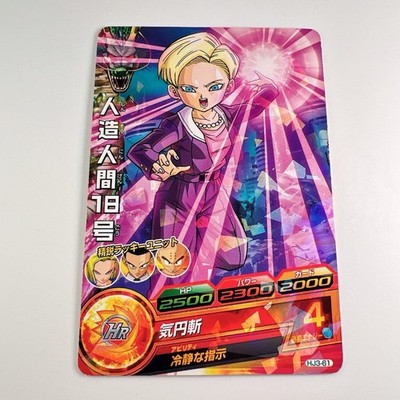
Android 18 Dragon Ball Heroes Arcade Card HJ3-61

A Dragon Ball Heroes Card from the Jaaku Mission Set
This card — number HJ3-61 — is a physical trading card from Dragon Ball Heroes, the arcade card game developed by Dimps and published by Bandai Namco Entertainment, which launched in Japan in November 2010. The “HJ” prefix in the card number identifies it as part of the Jaaku Mission campaign, one of the game’s early thematic series built around the powerful antagonists of the Dragon Ball Z era. The “3” places this card in the third set within that campaign, among the game’s earlier releases — estimated to be from around 2011 to 2012, though the precise release month is not confirmed in official archives.
The rarity designation is HR, or Hero Rare, which sits in the upper tier of the Dragon Ball Heroes rarity system. The card also carries the unit classification “Seiei Lucky Unit,” a category used within the game’s own mechanics. Unlike conventional trading cards sold through retail packs, Dragon Ball Heroes cards were distributed through arcade machines in Japanese game centers. Players insert the physical cards into dedicated cabinets to participate in digital battles — giving each card a dual identity as both a game component and a standalone collectible. The card’s surface carries full-foil treatment across the artwork, a presentation common to the game’s higher rarity tiers.
Android 18 and Her Place in the Dragon Ball Story
Android 18 made her debut in Dragon Ball Z during the Android and Cell Saga, introduced as a cyborg created by the villainous Dr. Gero. She enters the story as a formidable threat — disciplined, powerful, and working against the main cast — before her arc shifts considerably over the course of the series. She eventually marries Krillin and they have a daughter named Marron, one of the more complete character journeys in a franchise known for its vast ensemble. She has continued to appear as a main character in Dragon Ball Super.
The card’s illustration reflects this web of relationships directly. The small portrait panels along the bottom edge include Android 17, her twin brother, and Krillin, her husband — details drawn from the source material rather than the game’s own fiction. The technique listed on the card, Kienzan, is canonically one of Krillin’s signature moves, but it is assigned here to Android 18 within the Dragon Ball Heroes game system, an example of the creative latitude the game takes with its characters. A detail visible in the upper left of the artwork has been identified as Cell’s tail, a visual reference that fits squarely within the Jaaku Mission campaign’s focus on the Cell Saga period.
Arcade-Exclusive Origins and the International Appeal of Dragon Ball Z
Dragon Ball Heroes cards were never distributed through retail channels. They existed exclusively within the ecosystem of Japanese game centers, which means that outside Japan, the cards circulate only as imports — there has never been an official international distribution pathway. The Jaaku Mission sets, as early releases in a game that continued expanding for years afterward, surface less frequently than the many later sets that followed.
Dragon Ball Z has been broadcast across North America, Europe, Latin America, and Southeast Asia, and the Android and Cell Saga ranks among the story arcs with the broadest international recognition. Android 18 specifically has a strong following among fans worldwide. The artwork on Dragon Ball Heroes cards was created specifically for the game — purpose-made illustrations, not stills from the anime or manga — lending each card a distinct visual identity. In 2018, a spinoff anime titled Super Dragon Ball Heroes brought the game’s universe to a wider audience, raising the profile of the card series internationally.


Sleeved and rigid-mailed before it leaves Japan
$11.95
Ships internationally • More photos on the eBay listing