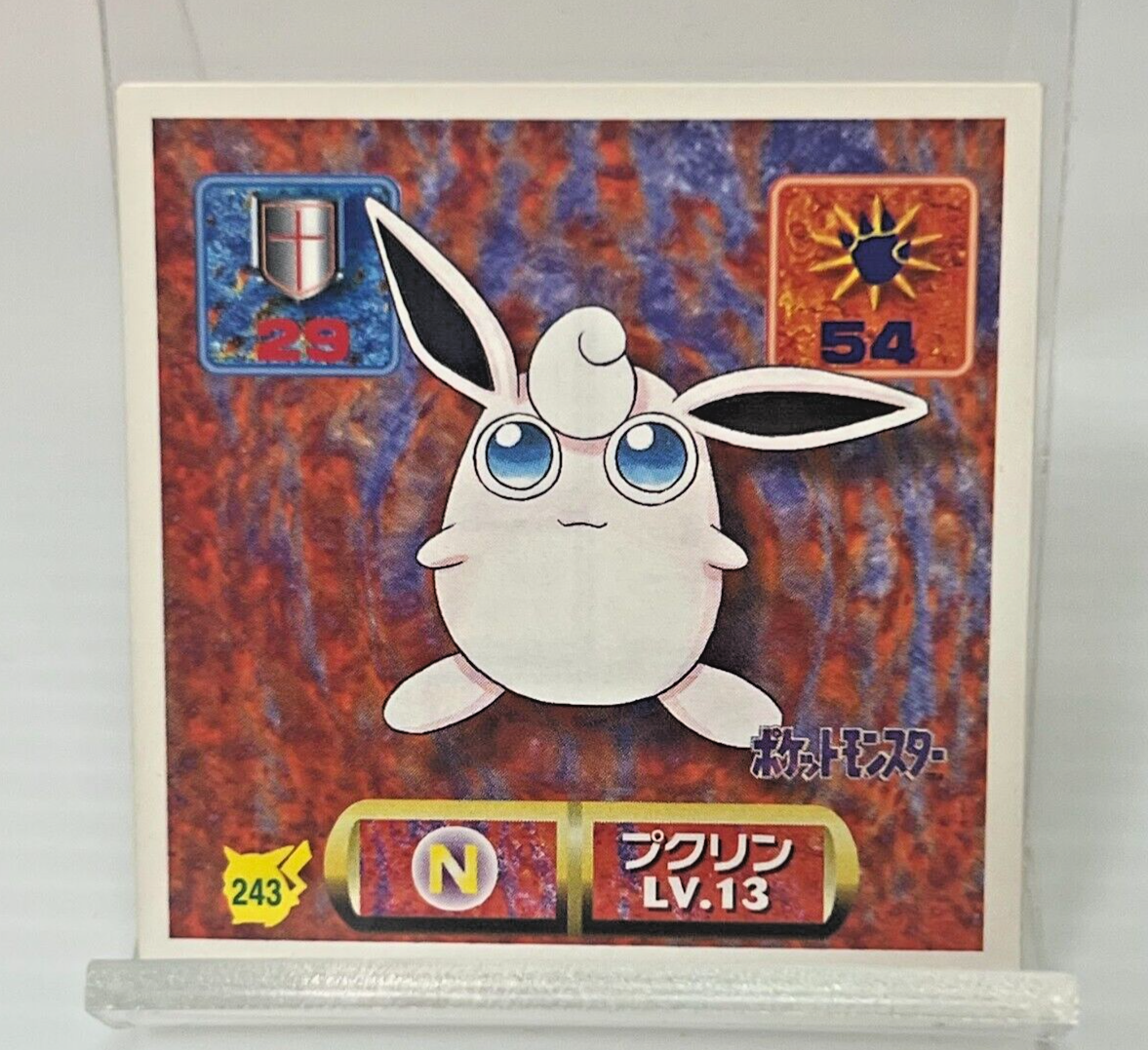
Wigglytuff Amada Pokemon Sticker No.243, 1997

A Card-Style Sticker Born in Pokemon’s First Year
This is a single rectangular sticker with a white border, issued by Amada — formally Amada Printing and Bookbinding Co., Ltd. — as part of a large numbered sticker collection produced during Japan’s first Pokemon craze. The item carries the series number No.243 in the lower left corner: this is Amada’s own sequential numbering for the collection, entirely separate from a Pokemon’s National Pokedex entry. Amada was a Saitama-based printing and toy manufacturer that produced licensed sticker and card products through much of the 1990s, working with popular franchises including Dragon Ball, Sailor Moon, and Pokemon.
The face of the sticker is designed to resemble an in-game status screen. A shield icon in the upper left displays the number 29, representing HP. The upper right shows a star mark and a paw-print icon alongside the number 54, values understood as representing other in-game statistics such as attack or defense. In the lower right, the label reads “Pukurin LV.13” — the Japanese name for Wigglytuff at level 13. A small “N” emblem appears at the bottom center, a marking found across Amada’s sticker series, though its precise significance has not been definitively established. The overall design deliberately connects the physical sticker to the world of the Game Boy RPG.
Wigglytuff and the World It Came From
Wigglytuff is a Normal-type Pokemon from the original 151, carrying National Pokedex number 40. It is the final evolution of Jigglypuff (No.39), reached through use of a Moon Stone. Both are pink, round, and associated with the ability to put audiences to sleep through singing. Jigglypuff became a recurring character in the early Pokemon anime series, which began airing on TV Tokyo in April 1997 — the same year this sticker was manufactured. Wigglytuff, as the evolved form, inherits a measure of that recognition.
The timing matters. Pokemon Red and Green launched in Japan in February 1996, the official trading card game arrived in October of that year, and the anime debuted in April 1997. This sticker was produced at the center of that convergence — a moment when demand for Pokemon merchandise expanded rapidly across Japanese toy stores, convenience stores, and candy shops. Amada’s sticker lines were among the many affordable licensed products that reached children through those channels during the period.
A Japan-Only Product from the Franchise’s Earliest Chapter
Pokemon did not officially reach overseas markets until late 1998 — the North American Game Boy release came in September 1998, and the trading card game followed in 1999. This Amada sticker predates all of that. It was manufactured for the domestic Japanese market and was not distributed internationally through regular retail channels.
For collectors focused on first-generation Pokemon merchandise, items from the 1996–1998 window represent the franchise’s original wave: produced when Pokemon was less than two years old and had no international footprint. The game-stat layout printed on the sticker — HP values, level notation, stat icons — reflects how early Japanese merchandisers connected physical collectibles directly to the Game Boy experience. Stickers of this type, printed on thin stock and prone to peeling and yellowing over time, are now approaching thirty years old, and the original-generation Pokemon fan base spans collectors who grew up with those games and a newer generation drawn to the franchise’s documented history.

Comes straight from Japan — no middleman
$7.86
Ships internationally • More photos on the eBay listing