Snoopy New Year's Postcard from Showa-Era Japan

Peanuts Comes to Japan for the New Year
Charles M. Schulz launched the Peanuts comic strip on October 2, 1950, introducing characters — Charlie Brown, Snoopy the beagle, and the small yellow bird Woodstock among them — that would eventually reach readers across more than 75 countries and 21 languages. Licensing rights were held for many years by United Feature Syndicate, Inc. (UFS), whose name appears in copyright notices on products from this period. The ©1958 and ©1965 dates found on Peanuts merchandise reflect copyright registration years for specific character designs, not the manufacture date of any given item.
In Japan, Peanuts grew into a cultural fixture from the 1970s onward, and much of its footprint was in paper goods: postcards, letter sets, and stationery. This New Year’s postcard was made for the Japanese market, most likely during the 1970s or 1980s while the appetite for character-branded paper goods during the Showa era was at its height.
A Beagle in a Kimono, Woodstock, and Mochi
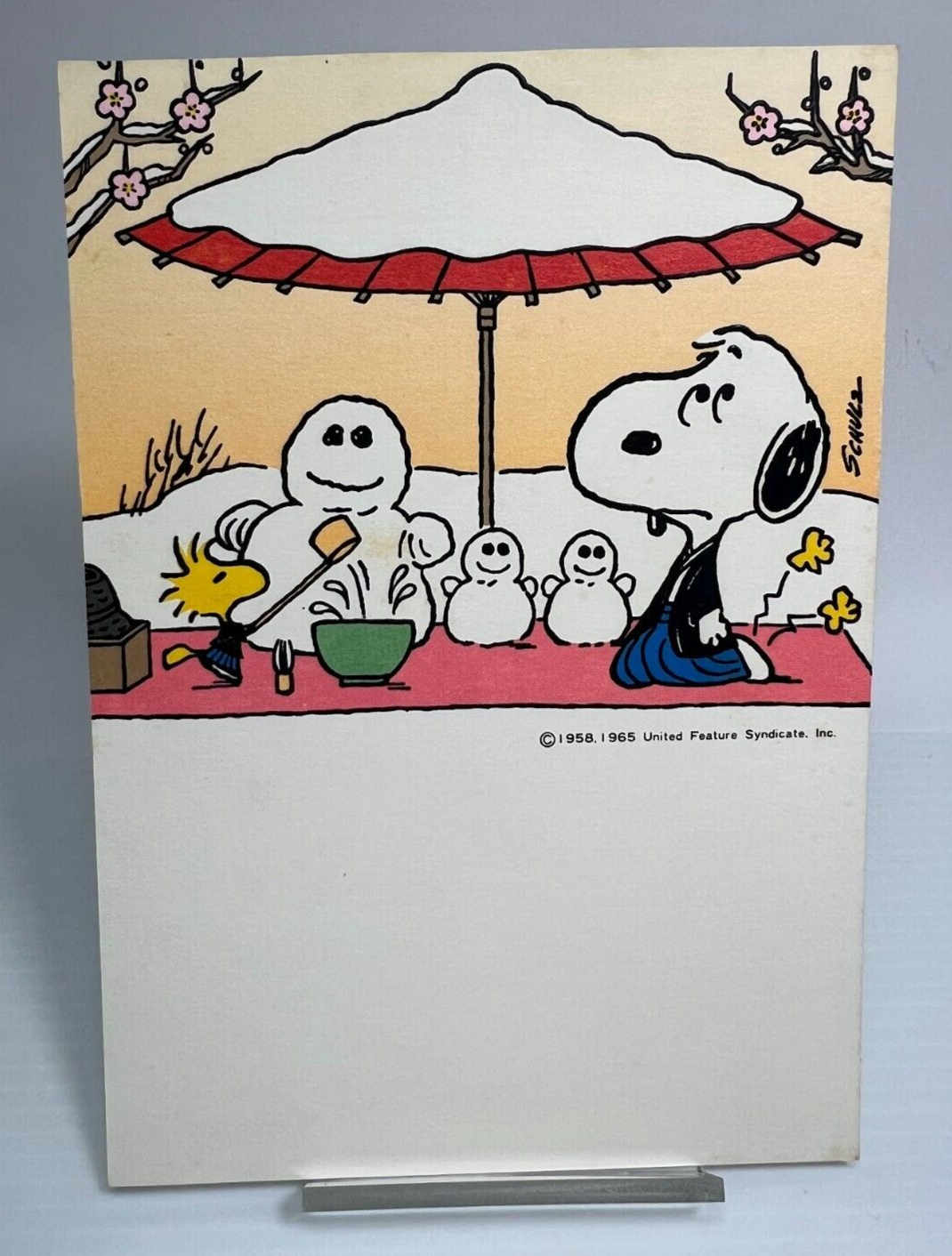
The illustration places Snoopy in a winter scene dressed in dark navy Japanese-style garb — clothing reminiscent of a haori or yukata — surrounded by snow and cherry blossoms. Cherry blossoms and snow do not actually share a season in Japan, but the pairing is a deliberate visual device, a shorthand for “Japanese-ness” familiar from decorative art of the period.
Woodstock, Snoopy’s small bird companion (named definitively in 1970 after appearing in the comics from around 1967), stands beneath a red-bordered wagasa — a traditional Japanese umbrella — alongside a snowman, seemingly preparing mochi or ozoni, the rice-cake soup central to Japanese New Year celebrations. Every element here — the wagasa, the mochi, the snow — belongs to the visual language of nengajo, Japan’s New Year greeting card tradition. Setting beloved American cartoon characters at the center of that imagery was a hallmark of Showa-era licensed goods, and it gives this design an aesthetic that was specific to Japan.
Hallmark, Sanrio, and Where This Card Fits
Both Hallmark and Sanrio were significant players in the Peanuts licensing world, though in different spheres. Hallmark Cards, the American greeting-card company, became a Peanuts licensee in the 1950s and produced a large volume of cards primarily for North American consumers. Sanrio — today synonymous with Hello Kitty, but in the 1970s and 1980s a leading Peanuts licensee in Japan — brought the characters to domestic stationery shelves through postcards, notebooks, and accessories. Whether this particular card was manufactured by Hallmark, Sanrio, or another party is not definitively confirmed from available information; both names appear in the listing, potentially reflecting different roles in production and distribution.
What is clear is the cultural context it came from. Peanuts paper goods from this period carry design conventions, copyright notations (the UFS credit, the dual 1958/1965 copyright years), and printing styles that were specific to their decade. As Japan’s nengajo tradition continues to be observed today, cards like this one serve as a snapshot of how mid-century American comics were translated into something genuinely Japanese — seasonal imagery, traditional food, festive props — one postcard at a time.

Listed in our eBay store and sent from Japan
$17.01
International shipping available • Ask us anything before you buy