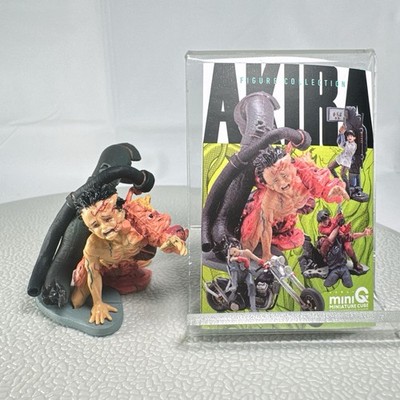
Kaiyodo miniQ AKIRA Part.2 — Tetsuo Fusion Figure

The Scene That Defined AKIRA’s Final Act
This figure depicts Tetsuo Shima at the moment his story reaches its most extreme point. In Katsuhiro Otomo’s landmark science fiction work — a manga serialized in Weekly Young Magazine from 1982 to 1990, and an animated film directed by Otomo himself in 1988 — Tetsuo begins as a teenager and childhood friend of protagonist Shotaro Kaneda. Military experimentation awakens latent psychic abilities in him, but the power spirals entirely out of his control, triggering a physical transformation he cannot stop.
The “Fusion” form captured here is the culmination of that collapse: Tetsuo’s body expands into a vast, organic mass of mutating flesh, overwhelming everything around him. It is among the most visually striking sequences in both the film and the manga, and it has become inseparable from AKIRA’s identity as a work. The figure renders this moment in miniature — a hunched, agonized pose, dark tube-like protrusions extending from the back and shoulders, reddish organic matter spreading across the surface, all set on an irregular grey base.
Kaiyodo and the Tradition of the Compact Collector Figure
The manufacturer is Kaiyodo, a Japanese figure maker based in Kadoma, Osaka, recognized among collectors in Japan and internationally for the precision of its sculpting and painting. Their miniQ line — the full name is Miniature Cube — packages pre-painted, finished figures inside compact, cube-shaped transparent plastic cases. Each figure comes backed by a card printed with other characters from the series, a presentation approach familiar to anyone acquainted with Japanese capsule toys, food toys, or small-format collector figures.
Kaiyodo played a significant role in establishing this style of collectible in Japan. In the late 1990s the company gained wide recognition through choco egg figures — pre-painted miniatures packaged with chocolate sweets — and that reputation for detailed sculpts in an accessible format has carried through to the miniQ line and its licensed collaborations. The AKIRA series ran across at least two installments, Part.1 and Part.2, with Tetsuo Fusion appearing in the second.
AKIRA’s Global Reach and Why This Character Resonates
AKIRA’s international profile is unusual even among celebrated anime films. Licensed versions reached North American and European audiences in the early 1990s, at a time when Japanese animation had very limited mainstream distribution abroad. That early exposure made the film a touchstone for an entire generation of international viewers, many of whom encountered it before the term “anime” had any wide cultural currency in their countries.
Within that global recognition, the Tetsuo Fusion sequence holds a particular place. The sheer physical grotesquerie of the form is difficult to capture convincingly in three dimensions, and figures that attempt it draw attention precisely because the subject is so demanding to sculpt. For collectors who complete series, the Part.2 designation carries its own weight: it marks this piece as part of a structured lineup, with other characters from across the AKIRA cast filling out the full set.


Boxed and cushioned for the trip from Japan
$18.49
Ships internationally • More photos on the eBay listing