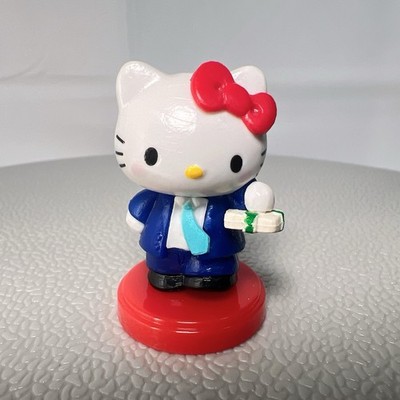
Hello Kitty Businessman Costume Collectible Figure by Sanrio

Hello Kitty — officially named Kitty White — is one of the most enduring characters in the history of Japanese popular culture. Designed by Yuko Shimizu in 1974 and first appearing on a coin purse in 1975, she has been the flagship character of Sanrio Co., Ltd. for half a century, with designer Yuko Yamaguchi later shaping the modern visual identity that most fans recognize today. Her simple, iconic face — a red bow over the left ear, dot eyes, a small yellow oval nose, six whiskers — has appeared on thousands of products across the globe, and 2024 marked her 50th anniversary.
This small static figure belongs to a long tradition of occupation and costume-themed Kitty goods. She stands on a glossy red circular base, dressed in a deep navy suit jacket over a white shirt with a light blue tie, holding a bundle of banknotes wrapped in a green band in her right hand. The figure is made from plastic or resin with no movable parts.
The Salaryman in Hello Kitty’s Costume Lineup
Occupation-themed Hello Kitty products have a well-established history in Japan. Chefs, nurses, pilots, brides, police officers — Sanrio and its licensees have dressed Kitty in a wide range of professional costumes over the years, playing on the contrast between her unmistakably soft kawaii aesthetic and the specificity of a work uniform. The salaryman look — navy suit, white shirt, tie — is a distinctly Japanese variation on this formula. Japan’s salaryman, the archetypal postwar office worker, is so embedded in the national imagination that placing Kitty’s face above a business collar immediately carries cultural associations that Japanese audiences would recognize at a glance.
The bundle of banknotes in her hand adds another layer of meaning. Imagery linked to money and prosperity has a long tradition in Japanese decorative objects, auspicious gifts, and good-luck charms. Whether the original designer was directly referencing that tradition or simply completing the “businessman at work” picture is unclear from the piece itself, but the result — a kawaii cat in a suit holding cash — lands in that particular sweet spot of funny, familiar, and culturally specific where the best Japanese character goods tend to operate.
Japan’s Tradition of Small Character Collectible Figures
Figures like this one have circulated through Japan for decades via multiple channels: gashapon vending machines, retail novelty shops, promotional gift campaigns, and corporate merchandise runs. Whether this specific piece originated as a capsule toy or a standalone retail item is not determinable from available information. Sanrio’s licensing model means that occupation-themed Kitty figures have been produced by a variety of manufacturers over the years, and individual pieces can be difficult to assign to a specific product line without the markings on the base — which in this case likely carries a Sanrio copyright stamp, though that detail is not visible in available images.
What makes Japan-market Sanrio pieces of particular interest to collectors outside the country is how differently they read from Hello Kitty merchandise produced for Western markets. The costume choices, cultural references, and design sensibilities tend to reflect specifically Japanese contexts. For collectors building a fuller picture of the character’s history across fifty years of global licensing, pieces like this — made for a domestic audience, referencing a specifically Japanese cultural type — represent a side of Hello Kitty that rarely reaches overseas retail shelves.


Boxed and cushioned for the trip from Japan
$14.07
International shipping available • Ask us anything before you buy