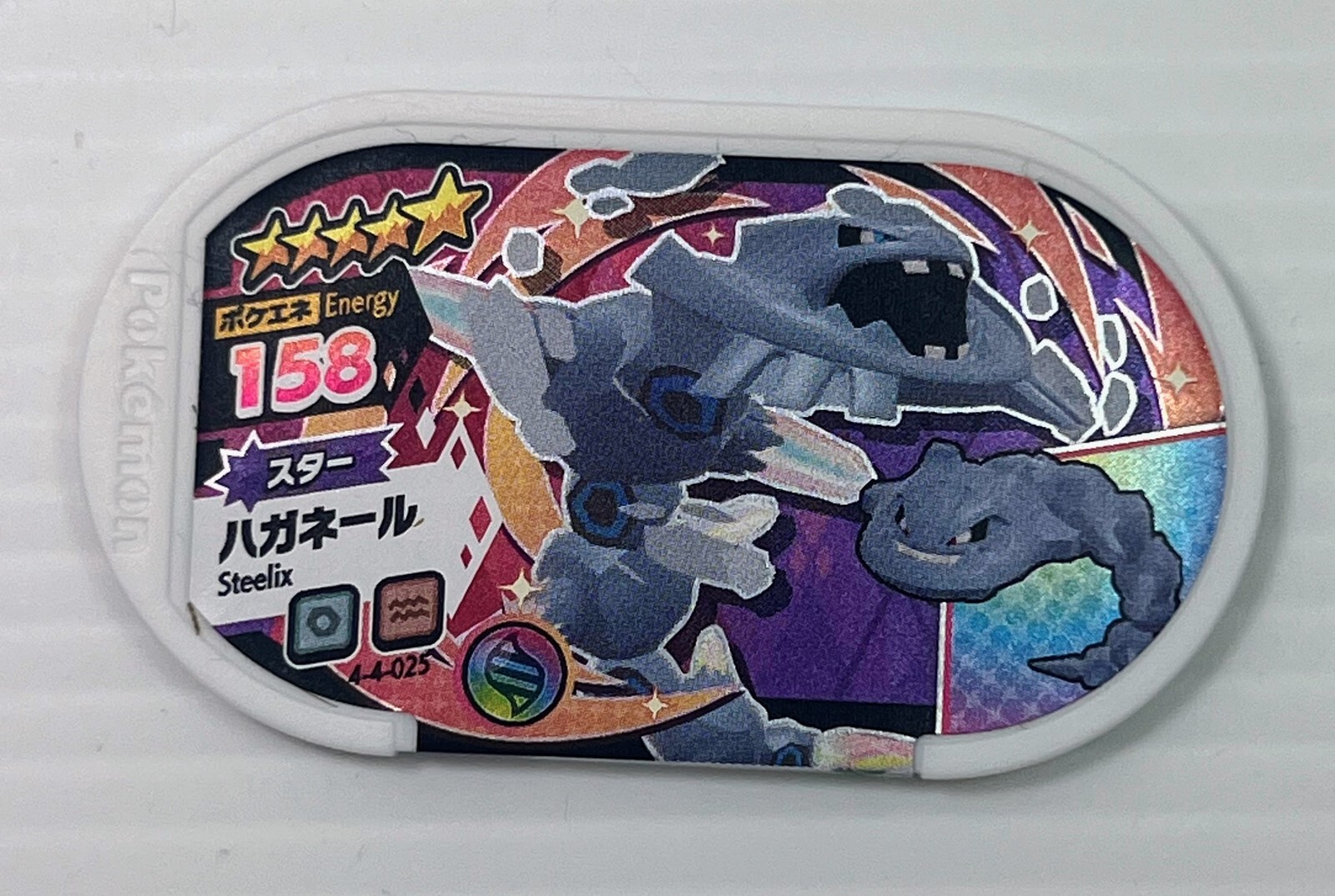
Pokémon Mezastar Series 4 Mega Steelix Arcade Tag

An Arcade Machine That Prints Its Own Collectibles
Pokémon Mezastar is a competitive arcade game developed by Taito Corporation — the studio behind Space Invaders — and deployed in Japanese game centers starting in July 2020. It is the successor to Pokémon Ga-Olé, which ran from 2016 to 2019, continuing a lineage of Pokémon arcade games where physical cards are as central to the experience as the gameplay itself.
The format works like this: play a round, and the cabinet ejects a physical tag. Each tag is an oblong plastic-framed piece with an illustrated insert sealed inside. It functions as an in-game piece scanned by the machine during play, and it also circulates on its own as a collectible item. This tag, numbered 4-025, belongs to Series 4 of the Mezastar lineup. The four yellow stars denote Super Star rank, the highest tier in the game’s ranking system. A small Onix illustration appears in the corner — a nod to Steelix’s pre-evolution and the link between the two Pokémon.
Taito handles both manufacturing the tags and operating the cabinets. The tags are not sold in stores; they come out of the arcade machine during play. For anyone outside a Japanese game center, the secondary market is the only route to ownership.
Steelix, Mega Evolution, and a Mechanic That Stepped Back
Steelix is a Steel/Ground-type Pokémon introduced in the second generation of games — Gold and Silver — and has been part of the franchise for over twenty-five years. It evolves from Onix when traded while holding a Metal Coat, a cooperation mechanic that added a layer of coordination for players who remembered arranging trades with friends. Steelix went on to appear prominently in the Johto-era anime, and has maintained a dedicated fan base ever since.
The Mega Evolution mechanic shown on this tag debuted in Pokémon X and Y in 2013. Mega Steelix keeps its Steel/Ground typing but shifts dramatically in appearance — its body segments become sharper and more crystalline, as though compressed and refined under immense pressure. Mega Evolution was last featured in the mainline Pokémon series in Omega Ruby and Alpha Sapphire in 2014 and has not returned to the core games since. It continues to appear in side releases: the Trading Card Game, arcade series like Mezastar, and similar products. The number 158 visible on the tag is likely a Mezastar-specific stat value related to a defensive parameter, though the precise in-game details are not fully confirmed in publicly available documentation.
Why Collectors Outside Japan Take Notice
The distribution model alone accounts for much of the international interest. Mezastar cabinets are installed almost exclusively in Japanese game centers, so the tags never reach retail shelves anywhere else in the world. Acquiring one outside Japan means either visiting a Japanese arcade in person or going through someone who has access to one — typically via the secondary market.
Beyond logistics, Mega Evolution carries real nostalgic weight for fans who were playing during the X and Y era. Its absence from newer games makes items that feature it — especially a high-tier Super Star-rank tag — meaningful to that generation of players. Steelix itself has a fan base reaching back to the late 1990s, and the character’s long history gives the tag a cross-generational appeal. The fact that all text on the tag is in Japanese, from the character name to the rank indicators, is precisely what collectors of Japanese-market originals look for: the native-language, domestic version of an item that was never produced anywhere else.

Shipped directly from Japan by a small shop
$8.82
Ships worldwide from Japan • Full photos and details on the listing