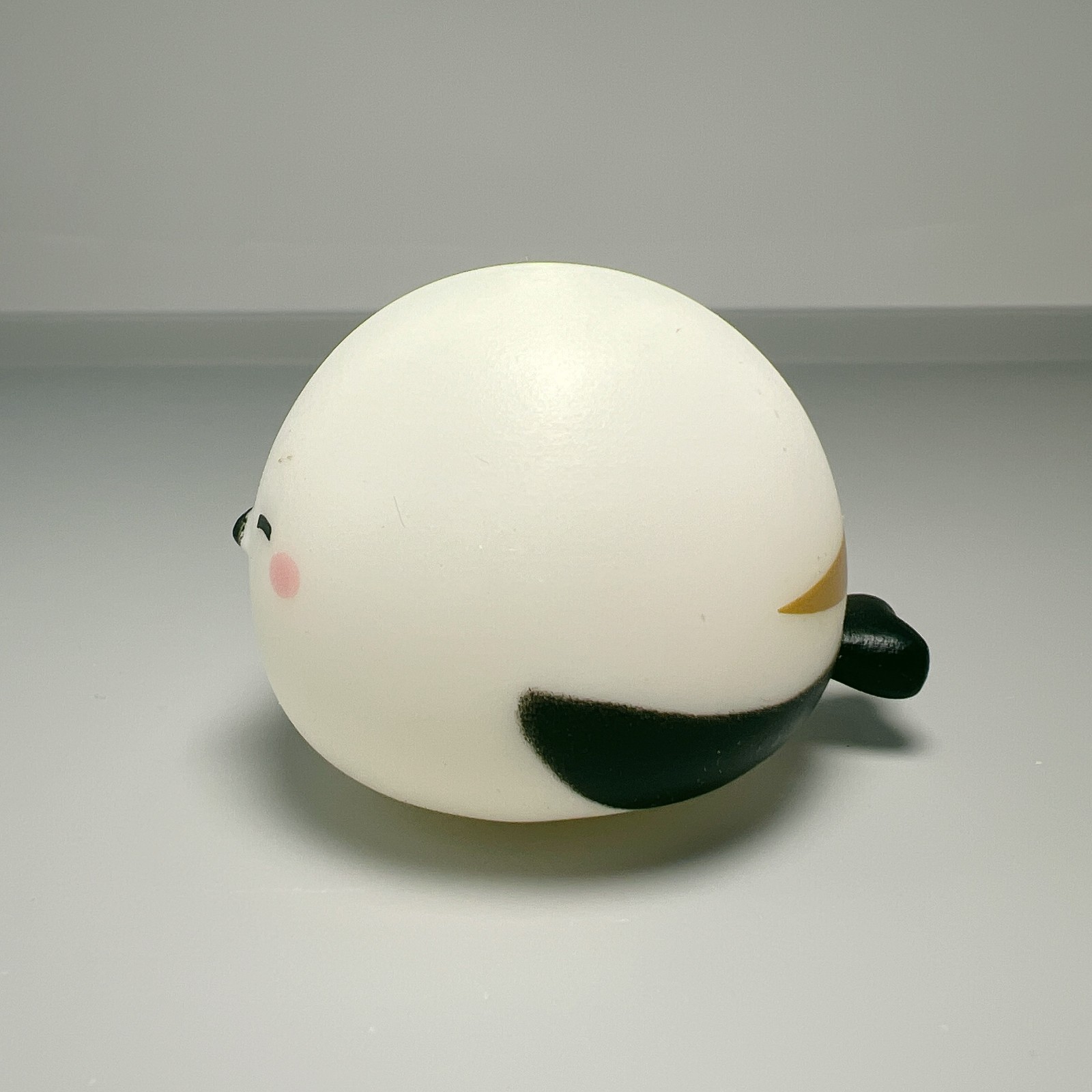
Puka Pottery Shimaenaga Sofubi Figure

Shimaenaga, the Bird That Became a Cultural Phenomenon
The Shimaenaga (Aegithalos caudatus japonicus) is a subspecies of long-tailed tit found only in Hokkaido, Japan’s northernmost main island. Unlike its mainland relatives, this subspecies has no dark facial markings, leaving it almost entirely white — a perfectly round, puffed-up silhouette that has earned it the nickname “snow fairy.” The bird became a social media sensation in the late 2010s, spreading widely on platforms like Twitter/X and Instagram under the informal title of “the world’s cutest bird.” That visibility translated into a surge in Hokkaido tourism and a wave of character merchandise: plush toys, photo books, food packaging, and vinyl figures like this one. The appeal is immediate and genuinely biological — the Shimaenaga really does look like a creature drawn from a cartoon, and no exaggeration is required to sell the comparison.
Puka Pottery and the Character Behind the Figure
The figure belongs to a brand called Puka Pottery, which developed an original character named Puka around the Shimaenaga’s most distinctive traits. The name “puka” is a Japanese word suggesting something gently floating on water or drifting through the air — a fitting description of the bird’s airy, weightless appearance, and the direct source of the product description “Floating Collectible.” Whether “Pottery” in the brand name refers to a literal craft or evokes a textural warmth in the figure’s surface isn’t confirmed in available sources. What is clear is that this is an independent original character concept, not a tie-in to any anime, game, or established media franchise. The figure captures the real bird’s key visual traits in stylized form: a rounded white body, small black eyes, dark tail feathers, and a yellow accent at the back — all translated into the exaggerated, simplified proportions that define sofubi character design.
Sofubi — shorthand for soft vinyl — is a distinctly Japanese toy format with roots in the 1960s Kaiju boom, when toy companies began producing hollow, flexible figures of monsters from Ultraman and Godzilla. By the 1990s, independent artists had reclaimed the medium, making small production runs sold at events like Wonder Festival or through direct order. Contemporary kawaii-style sofubi — matte finishes, rounded forms, minimal color palettes — sits in its own lane within that tradition, often functioning as much as a decorative object as a conventional toy.
Where Independent Character Culture and Bird Fandom Meet
Since the 2010s, Japan has seen steady growth in original character IP built around real animals and regional wildlife, and the Shimaenaga sits near the center of that phenomenon. It is a rare case where the real creature essentially handles the character design on its own — the softness, the whiteness, the almost weightless round form all map directly onto kawaii aesthetics without any artistic license needed. For collectors drawn to Japan’s independent art toy scene, a piece like this represents something specific: a small-batch vinyl figure born from a creator’s response to a particular cultural moment, with no major corporation behind it and no franchise continuity to follow. The Japanese art toy world has had documented cross-influence with international art toy communities for decades, so the sofubi format is already familiar to collectors far beyond Japan — even when the subject matter, a rare Hokkaido bird nicknamed the snow fairy, is unmistakably local.


Boxed and cushioned for the trip from Japan
$10.65
Ships internationally • More photos on the eBay listing