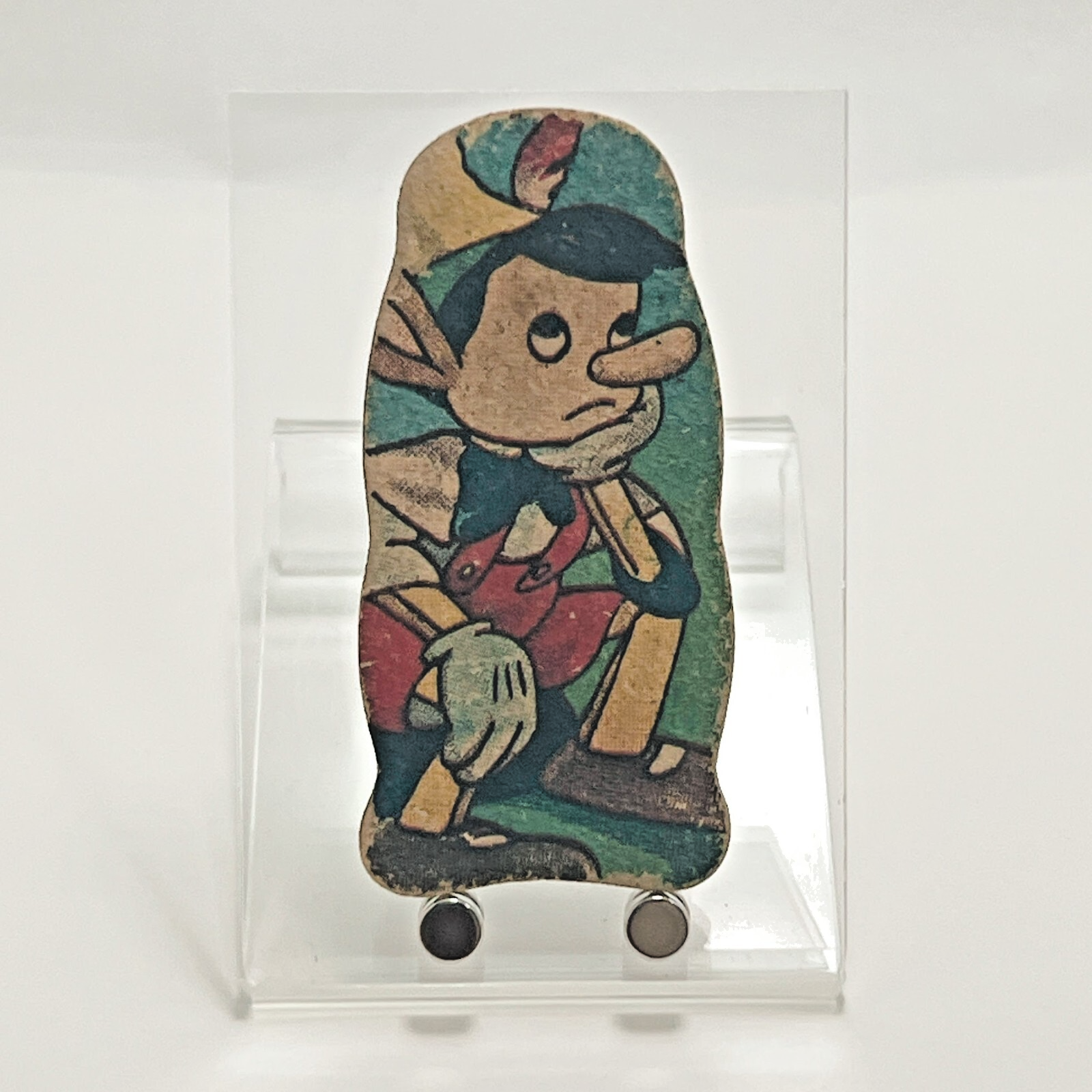
Pinocchio Showa-Era Die-Cut Menko Card

A Traditional Game Card with a Famous Face
Menko are a traditional Japanese children’s game with roots going back to the Edo period. Players take turns slapping thick cardboard cards onto the ground, trying to flip the opponent’s card over — whoever succeeds takes it. Through the Showa era, the format evolved from simple geometric shapes into licensed character cards featuring baseball stars, sumo wrestlers, and eventually animated film icons.
This card is a die-cut menko, meaning the cardboard has been cut to follow the character’s actual silhouette rather than a standard rectangle or circle. Die-cut menko require more involved production than conventional versions, and they became especially popular during the 1960s and 1970s. The format gives the card an immediate visual impact that a flat rectangle cannot match, and it works equally well as a standalone display piece.
From a 1940 Disney Film to a Showa-Era Toy Shelf
Walt Disney Productions released Pinocchio in 1940, its second feature-length animated film after Snow White and the Seven Dwarfs (1937). The story draws on Carlo Collodi’s 1883 Italian novel and follows a wooden puppet named Pinocchio who dreams of becoming a real boy. His nose growing whenever he tells a lie has become one of the most widely recognized character traits in children’s storytelling worldwide.
Pinocchio first reached Japanese theaters in 1952, in the post-occupation years when American cinema was entering Japan in larger numbers. Re-releases and television broadcasts through the following decades established the character firmly in Japanese popular culture. By the high-growth years of the 1950s and 1960s, Japanese manufacturers were entering licensing agreements with American entertainment companies, producing Disney-character goods for the domestic market — menko cards among them.
The illustration on this card matches Pinocchio’s classic 1940s design: yellow hat with a red feather, blue-toned jacket, the warm flat colors characteristic of hand-drawn cel animation. That visual language — bold black outlines, opaque fills — is specific to the pre-digital era of animation and distinct from anything produced after computer coloring became standard.
What Draws Collectors to Showa Disney Menko
Disney merchandise from the Japanese market has long attracted collector interest because items produced for Japan were designed and manufactured locally, for local children, in formats that had no equivalent in the West. A Showa-era Pinocchio menko is not a Japanese version of an American product — it is something that existed only here, in a toy format native to Japan.
The growing international interest in Showa Retro — the popular culture of roughly 1955 to 1989 — has brought more attention to menko as a collecting category. Die-cut examples are a visually distinct subset: the shaped silhouette is easier to display and immediately more striking than a rectangular card. For anyone drawn to early Disney animation, Japanese toy history, or the overlap between the two, this card sits at a specific intersection of both. The exact manufacturer and production year cannot be confirmed from the available information, but the design and materials place it squarely within a well-documented chapter of Japanese licensed toy production.

Listed in our eBay store and sent from Japan
$9.75
International shipping available • Ask us anything before you buy