1951 Matsushita Electric Iron — Time Slip Glico by Kaiyodo

A Candy Box Packed With Postwar History
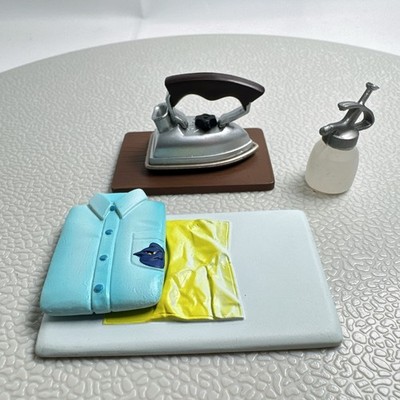
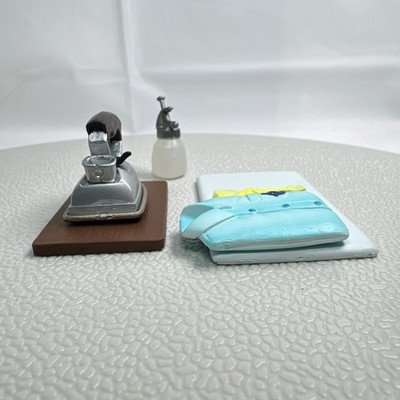
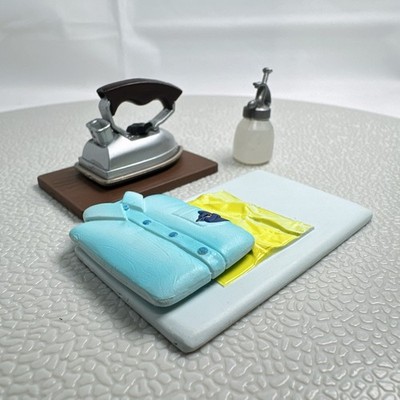
This is a shokugan — a Japanese confectionery toy — released as part of the Time Slip Glico series by Ezaki Glico, with sculpting by Kaiyodo. Rather than a single figurine, it is a miniature diorama: a 1951 Matsushita Electric iron, an ironing board, a spray bottle, and a small shirt, arranged to recreate a scene from an early postwar Japanese home.
The subject carries genuine historical weight. Matsushita Electric — the company now known as Panasonic, founded by Konosuke Matsushita in 1918 — was already one of Japan’s most significant manufacturers when it produced the iron this piece models. The year 1951 (Showa 26) falls during Japan’s economic recovery period, when procurement tied to the Korean War was helping rebuild industry and consumer confidence. Electric irons were among the first modern appliances to reach middle-class households, arriving before the celebrated “Three Sacred Treasures” — the black-and-white television, washing machine, and refrigerator — that came to define household prosperity through the latter half of the decade. In 1951, a Matsushita electric iron in the home stood as a small but meaningful marker of modern domestic life.
The diorama format goes further than simply reproducing the iron. By including the ironing board, spray bottle, and shirt alongside it, the set stages an entire domestic moment — the kind of scene that would have been ordinary in a Showa-era household and is now a form of social history in miniature.
Kaiyodo and the Shokugan Revolution
Shokugan — confectionery toys with a small figurine or premium included — have existed in Japan since the postwar era, descending in spirit from early promotional giveaways like the original Glico caramels that came with a small toy prize. For decades, these were understood as children’s products. What changed, in the late 1990s and early 2000s, was the arrival of Kaiyodo.
Kaiyodo, based in Kadoma, Osaka, had built its name on high-detail figure sculpting. When the studio began collaborating on shokugan, the resulting miniatures attracted a different audience entirely: adult collectors, design publications, and museum curators who recognized the quality of the work. The Time Slip Glico series, which launched around the time of Glico’s 80th anniversary in the early 2000s — though the exact schedule across its multiple installments has not been exhaustively documented — was among the clearest expressions of this shift. Its concept, to faithfully miniaturize the everyday objects of postwar Japanese homes, required exactly the kind of craftsmanship Kaiyodo was known for. The target buyer was someone in their thirties or forties: old enough to remember the Showa era being miniaturized, or at least to feel its pull.
What Draws Collectors to This Piece
Kaiyodo’s reputation is well established among figure collectors internationally, and the Time Slip Glico collaborations remain a reference point in discussions of what shokugan became at their creative peak. Beyond the studio’s name, the 1951 iron diorama offers something specific: a scale model of a real Matsushita product from a particular year, presented within a complete domestic context. For collectors interested in postwar Japanese industrial or social history, that specificity has its own appeal.
Because shokugan were sold with randomized assortment — buyers received whichever piece happened to be in the package, with no ability to choose — obtaining any single item typically required multiple purchases or secondary-market sourcing. For buyers outside Japan, where this type of product was never widely distributed, individual pieces from the series are less frequently encountered.




Boxed and cushioned for the trip from Japan
$14.07
Worldwide delivery from Japan • See the listing for condition and size