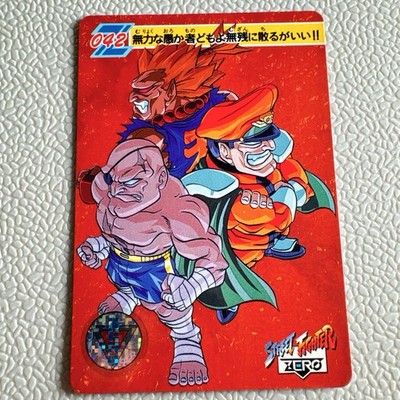
Bandai Carddass Street Fighter Zero Card No.042 (1995)

Three Villains on One 1995 Card
This is a single card from Bandai’s Carddass trading card line, catalogued as No.042 and released in 1995 alongside the arcade debut of Street Fighter Zero — the game distributed in Western markets as Street Fighter Alpha. A “Z” logo marks the upper-left corner, and a circular rainbow hologram sticker with a “V” motif sits in the lower-left, a premium feature Bandai applied to certain Carddass cards to distinguish them within a set. The artwork uses SD (super-deformed) style: exaggerated, chibi-like proportions that look quite different from either the game’s own sprites or its official character illustrations.
The card depicts M.Bison, Sagat, and Akuma. M.Bison (called Vega in Japan) commands the criminal organization Shadoloo using a force called Psycho Power and serves as the Zero series’ central villain. Sagat was once the world’s strongest fighter before losing to Ryu in the original Street Fighter, a defeat that left him with a scar across his chest. Zero is set around that loss and Sagat’s complicated drift toward Shadoloo, which gives him more narrative depth than his later appearances. Akuma (Gouki in Japan) debuted as a hidden character in Super Street Fighter II Turbo in 1994 and became fully playable in Zero; his enigmatic presence has made him one of the most discussed figures in the entire franchise.
Carddass and the Trading Card Boom of 1990s Japan
Bandai launched Carddass in 1988 as a coin-operated vending card system, placing dedicated machines in toy shops, bookstores, and convenience stores across Japan. A customer inserted a coin and received a single card — no food packaging, no capsule, just the card itself. The primary audience was school-age children, and buying and trading cards on the way to and from school became a recognizable part of 1990s Japanese youth culture. Bandai licensed a wide range of popular properties — Dragon Ball, Kamen Rider, and, following the global success of Street Fighter II in 1991, the Street Fighter series. Hologram stickers and foil finishes created visible tiers of desirability within each set. Carddass was a Japan-domestic system with no official overseas distribution.
Why These Three Characters Still Draw Attention
Street Fighter broke through cultural and language barriers in a way few early-1990s video game franchises managed. M.Bison, Sagat, and Akuma are all familiar to fans well outside Japan, and Akuma in particular has maintained a devoted following — his debut as a secret fighter, the mythology surrounding his fighting philosophy, and his recurring role across the series have kept him a subject of ongoing interest among fighting-game fans for over thirty years.
A card like this sits at the intersection of a globally recognized franchise, three high-profile characters, SD artwork that occupies a visual register separate from the rest of the Street Fighter catalog, and a product format that never left Japan. Paper cards from 1995 carry the ordinary effects of age, and the hologram sticker introduces an additional variable: stickers that have stayed intact over three decades are less common than those showing some degree of wear or lifting.


Sleeved and rigid-mailed before it leaves Japan
$10.94
International shipping available • Ask us anything before you buy