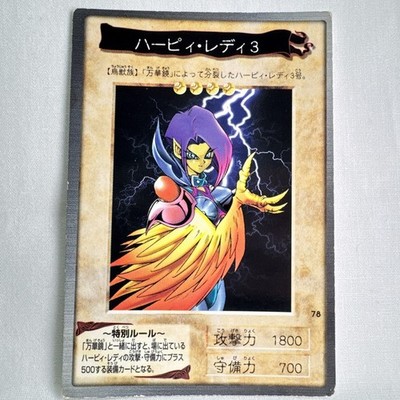
Harpie Lady 3 — Bandai Carddass No.78, Yu-Gi-Oh Part 3 (1999)

Harpie Lady and Her Place in the Yu-Gi-Oh Story
Harpie Lady is one of the most enduring monsters in the Yu-Gi-Oh franchise — a winged humanoid drawn from the harpy figures of Greek mythology, recognizable by her green skin, purple hair, and broad orange wings. In Kazuki Takahashi’s original manga, which began serialization in Weekly Shonen Jump in September 1996, she serves as the signature monster of Mai Kujaku — known to English-speaking audiences as Mai Valentine — one of the most memorable rival duelists in the series. The character and the card became so closely tied that Harpie Lady carried real weight as a marker of Mai’s identity across the manga and the 1998 Toei Animation anime.
In the Bandai card game, Harpie Lady 1, 2, and 3 appear as three separate individual cards — a different approach from Konami’s later Official Card Game, which combined them into a single fusion monster called Harpie Lady Sisters. Card No.78 in the Part 3 lineup, this Harpie Lady 3 carries stats defined entirely by Bandai’s own ruleset: ATK 1800, DEF 700, Level 5, Winged Beast-Type — figures that differ from anything Konami would later publish for the same character.
Bandai’s Carddass and the Vending Machine Era
Bandai’s Carddass format had been running since 1988 — a vending machine system installed in candy stores, convenience stores, and game centers across Japan that dispensed random cards at roughly 20 yen each. By the 1990s it had become a genuine cultural phenomenon, with children queuing in front of machines stocked with Dragon Ball, Sailor Moon, and other major franchises. Yu-Gi-Oh fit naturally into this world, and Bandai’s licensed series ran through multiple releases — Part 1, Part 2, Part 3, and beyond — in approximately 1998 and 1999.
Bandai held a license directly from Takahashi and Shueisha before Konami’s Official Card Game launched in February 1999. The two products briefly coexisted, but as Konami’s competitive OCG expanded and became the global standard, Bandai’s version exited quietly. The production window was narrow, distribution stayed entirely within Japan, and no formal export followed. Because Bandai’s system had no competitive tournament structure behind it, the cards functioned from the start as character merchandise as much as game pieces — closer in spirit to the broader Carddass collector culture than to the trading card game that would follow.
What This Card Represents for Yu-Gi-Oh Collectors
For fans of Mai Valentine, this card holds a particular kind of appeal: it depicts her defining monster in an artwork and format that existed before the global card game shaped how most people think about Yu-Gi-Oh. The stat values, card layout, equipment effect text, and frame design — this one finished with a metallic silver border that places it among the higher-rarity cards in the Part 3 set — all belong to a standalone system that no longer exists anywhere in active play.
Collectors drawn to Yu-Gi-Oh’s early history treat the Bandai series as documentation of a brief, Japan-only chapter that unfolded in parallel with the franchise’s rise and then closed before most of the world was paying attention. A card manufactured over 25 years ago for a domestic market that was itself transitioning, it sits at an unusual intersection: franchise history, Carddass culture, and a version of a beloved character that the mainstream game never quite replicated.


Sleeved and rigid-mailed before it leaves Japan
$8.82
International shipping available • Ask us anything before you buy