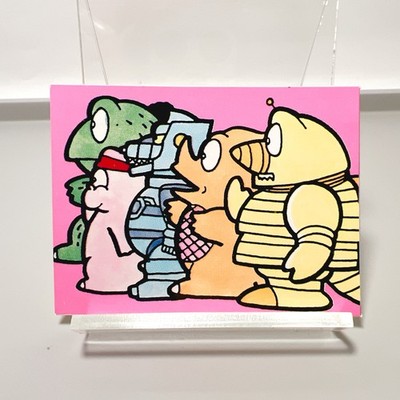
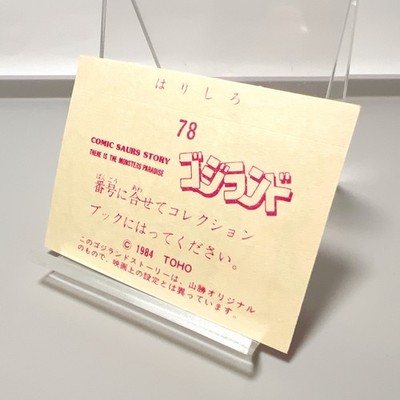
Godzilland No.78, a Numbered Kaiju Sticker from 1984

Five Chibi Monsters on a Single Pink Card
This item is a single flat sticker card, rectangular and printed on a pink background, depicting five SD-style (super-deformed, or chibi) kaiju characters. It carries the number “No.78,” which strongly suggests it was produced as part of a serialized numbered collection — a common format for Japanese character sticker goods of the 1980s. The characters are rendered in the Godzilland visual style: rounded forms, bold outlines, and saturated colors that transform Toho’s most famous monsters into compact, friendly-looking versions of themselves.
Based on visual characteristics, the five figures appear to include a blue robot type consistent with MechaGodzilla, a yellow character with antenna-like protrusions that matches Gigan’s silhouette, and others plausibly identified as Godzilla himself, Rodan, or Anguirus — all regular members of the Showa-era Toho monster lineup. These identifications are reasonable but not definitive from the card alone.
The Year Godzilla Returned
The 1984 date on this sticker connects it to one of the most significant moments in the franchise’s history. After the Showa series concluded in 1975, Godzilla was absent from Japanese cinemas for nine years. In 1984, Toho brought the franchise back with The Return of Godzilla, marking the start of what would become the Heisei series. That revival generated a broad wave of licensed merchandise, and small-format goods like stickers, erasers, and card sets were produced in large quantities for the children’s market.
The Godzilland line had been active since the early 1980s, applying SD character design to Toho’s kaiju roster across a range of product categories. Multiple manufacturers worked under Toho licensing to produce Godzilland goods; the specific maker of this sticker is not identifiable from the item itself, though companies including Bandai, Popy, and Eiko were among those active in this space at the time. The “TOHO” mark on the item reflects the licensor, not necessarily the manufacturer.
Numbered Stickers and the Collecting Culture Behind Them
In 1980s Japan, numbered collectible stickers were central to children’s everyday culture. Sold at candy stores, toy shops, and stationery retailers — sometimes tucked inside snack packaging, sometimes sold individually — they were designed to be collected as complete sets. A serial number like “No.78” locates this card within a sequence, giving it the double function of standalone item and piece of a larger puzzle.
The SD chibi aesthetic that defines the Godzilland style is a distinctly Japanese approach: taking creatures defined by their scale and menace and redesigning them as small, round, and approachable. This sensibility was a defining feature of 1980s Japanese character merchandising and later carried forward into properties like SD Gundam. For collectors outside Japan with an interest in Showa-era Toho material or 1980s Japanese pop culture, Godzilland pieces occupy a specific niche — kaiju in an unambiguously cute register, quite different from the screen monsters that inspired them.
Paper and film stickers from this era were not intended to be preserved; they moved through children’s hands freely and were subject to typical wear. Items that have survived in clean condition from this period represent a relatively small share of original production, though that reflects a general pattern common to low-cost printed goods from the decade.


Listed in our eBay store and sent from Japan
$8.82
International shipping available • Ask us anything before you buy