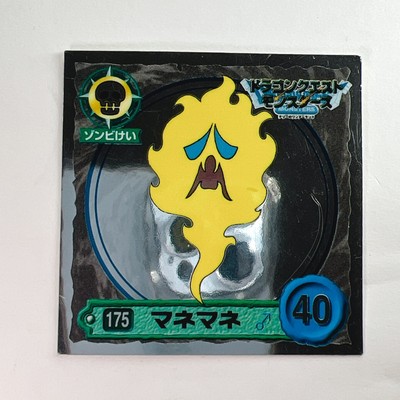
Dragon Quest Monsters Manemare Trading Sticker No. 175, Silver B, 1998

Terry’s Wonderland and the Zombie Monster Called Manemare
Dragon Quest Monsters: Terry’s Wonderland launched in September 1998 as a Game Boy Color RPG from Enix — a monster-raising spin-off of Dragon Quest IV (1990) that placed the fan-favorite supporting character Terry at the center of his own adventure. Its structure, in which players recruit, breed, and train monsters for battle, arrived during a monster-collecting boom in Japan set in motion by Pokemon’s breakout two years earlier. The game sold widely to a young audience and triggered an immediate wave of licensed merchandise.
This sticker features Manemare, a zombie-type monster whose name derives from the Japanese word for “imitation” or “mimicry.” The character appears as a yellow flame-like spirit with sad blue eyes and a wide brown mouth — a design by Akira Toriyama, whose character art defines every creature across the Dragon Quest universe. The sticker records Manemare’s type classification (zombie-type, indicated by an icon in the upper left), its position in the series (No. 175), and a blue-circled figure of 40 that likely reflects an in-game statistic, though the exact parameter it corresponds to isn’t confirmed.
Japan’s Trading Sticker Culture and the Silver B Format
Trading stickers — collection seals sold at dagashiya (penny-candy shops), supermarkets, and convenience stores — were central to children’s media culture in Japan through the 1980s and 1990s. The “collect them all” format, made popular by Bikkuri Man stickers, was routinely applied to major licensed properties including game franchises like Dragon Quest. A series numbered at least as high as 175 is characteristic of these comprehensive sets, designed so no single purchase completed the collection.
The “Silver B” designation points to a metallic or holographic finish variant. In sticker releases of this era, it was standard practice to produce parallel tiers — a base version alongside silver and sometimes gold premium editions — differentiated by their surface treatment. Whether this sticker was sold packaged with candy (shokugan), in a blind pack, or through another retail channel isn’t confirmed. The manufacturer is similarly unconfirmed; Amada was the dominant producer of Dragon Quest and Jump-licensed trading stickers during this period, with Bandai also holding comparable licenses, but neither can be confirmed from the listing alone.
Toriyama’s Legacy and What the 1998 Release Represents
Akira Toriyama, who passed away in 2024, designed the monsters and characters for every mainline Dragon Quest title across nearly four decades. His contribution gives the series one of the most recognizable visual identities in Japanese RPG history, and it is why his name appears in collector documentation for goods from this era. Dragon Quest Monsters later expanded internationally under the “Joker” sub-brand, earning the franchise genuine recognition outside Japan. The original 1998 game and its merchandise, however, never saw a Western release — making items like this sticker specific to the Japanese domestic market at the moment the DQM line first launched.


Shipped directly from Japan by a small shop
$7.86
Ships worldwide from Japan • Full photos and details on the listing