Android 16 Dragon Ball Z Super Warrior Seal Wafer Sticker by Bandai

A Foil Sticker From Japan’s Food-Toy Era
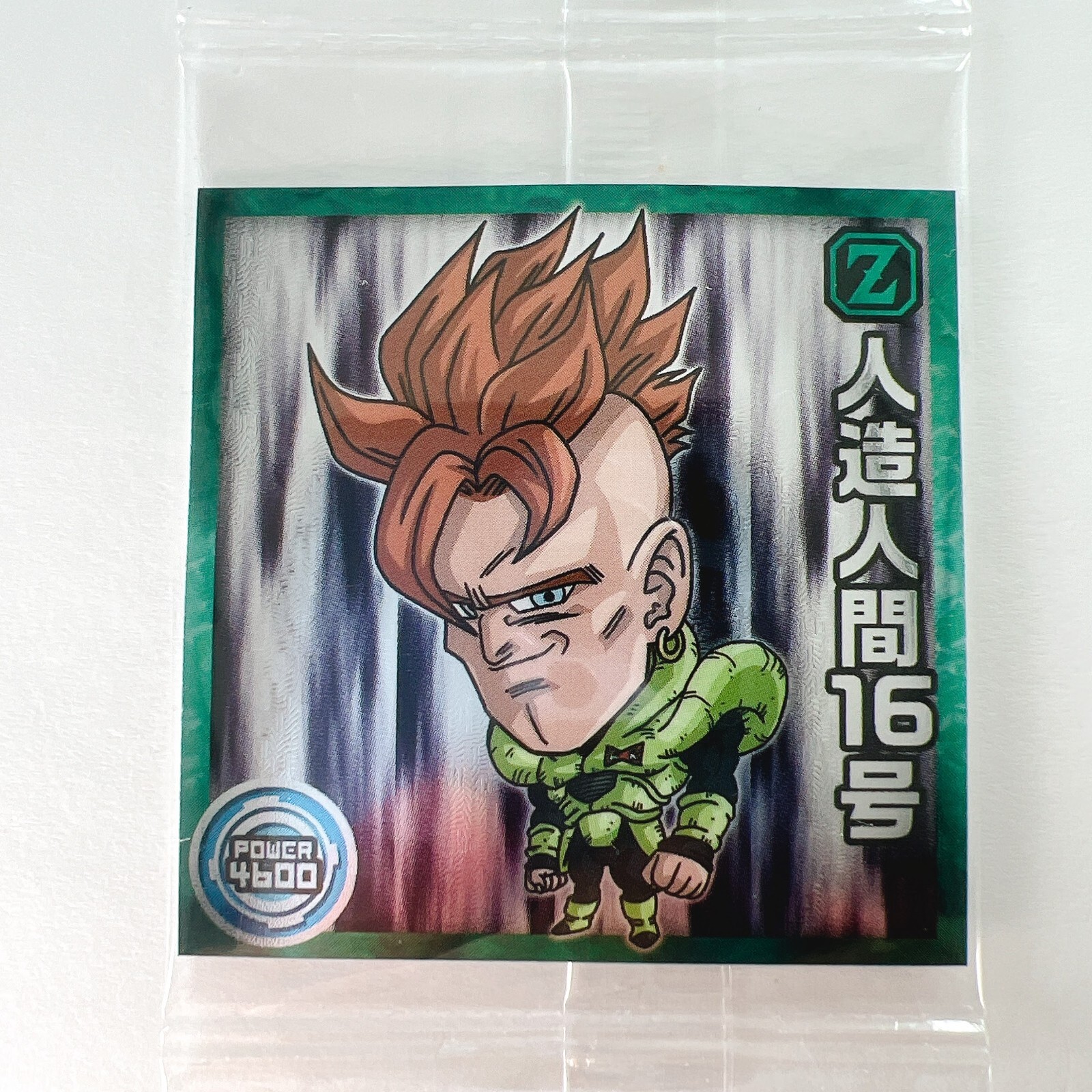
This is a single sticker card from Bandai’s Super Warrior Seal Wafer series — a line of collectible stickers sold inside packages of thin wafer biscuits across Japan during the 1990s. The item number #12-11 most likely identifies this as Series 12, card 11 within that set, following the numbering format Bandai used consistently across its candy-toy sticker lines, though the exact release year falls somewhere in the early-to-mid 1990s rather than any single pinpointable date.
The sticker is printed on foil stock with a holographic, metallic background — a finish Bandai applied widely to its candy-toy products during this period. A bold “Z” logo inside a green border appears on the face, confirming official Dragon Ball Z licensing. Along the lower edge, the figure “POWER 4600” is printed; this is most likely a game-play value specific to Bandai’s own system for this sticker line, separate from the power levels described in the original series.
Android 16 and the Cell Saga
Android 16 appears in Dragon Ball Z’s Cell Saga, which aired in Japan from roughly 1991 to 1993. He is a fully mechanical android — unlike his companions, Androids 17 and 18, who are cyborgs — built by the villain Dr. Gero with the single purpose of defeating Son Goku. What distinguishes him within the story is his temperament: unhurried, gentle, and genuinely attached to living things and nature, which sits in striking contrast to his designed role as a weapon.
His most significant scene in the series comes near the saga’s end. Badly damaged in battle, Android 16 speaks directly to Gohan — Goku’s son — urging him to fight for the people and world he loves. That moment is widely identified by Dragon Ball Z fans as the emotional catalyst that triggers Gohan’s transformation into Super Saiyan 2, one of the most celebrated sequences in the entire franchise. Visually, he is immediately recognizable: a large frame, reddish-brown spiked hair cropped close on the sides, green armor, and the Red Ribbon Army emblem on his chest — the same mark visible in the sticker’s artwork.
The Culture Behind Bandai’s Wafer Sticker Lines
The shokugan format — candy or snack packaged with a small collectible — was central to Japanese children’s consumer culture through the 1980s and 1990s. Wafer stickers were sold at corner stores, supermarkets, and convenience stores, each package containing one sticker chosen at random. The chance element was the point: pulling a specific character required patience and repeated purchases, and hunting for a favorite drove the format’s popularity across multiple Dragon Ball Z series releases.
Bandai was among the most active producers of Dragon Ball Z merchandise throughout this era, and a line running to at least Series 12 indicates sustained demand over several years. For collectors outside Japan, items from this line carry particular significance: they represent original Japanese-market artwork, Japanese text, and the visual language of the source country’s official licensing — entirely distinct from the localized Dragon Ball Z products that reached North America and Europe later in the decade, and from a character whose role in the story has kept his fan following strong long after the Cell Saga concluded.


Found in Japan, packed by hand, sent worldwide
$9.65
Worldwide delivery from Japan • See the listing for condition and size