Vintage Daitarn 3 Menko Card, circa 1978–79

A Super Robot at the End of an Era
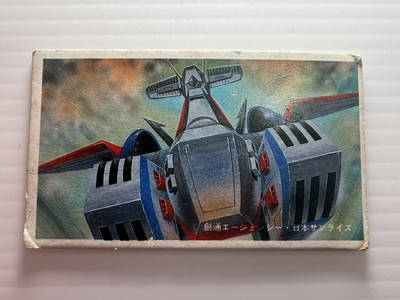
This rectangular menko card carries a full-color image of Daitarn 3 — the 120-meter giant robot from the 1978–79 anime Muteki Koujin Daitarn 3 — printed on thick cardstock in the style typical of Japan’s late-1970s toy market. A copyright notice for Sotsu Agency and Nippon Sunrise printed on the card confirms it as an officially licensed product from the show’s original broadcast run, not a later reproduction.
Daitarn 3 aired on Nagoya Television (TV Asahi network) from June 1978 to March 1979, running 40 episodes. The series belongs to the super robot lineage that began with Mazinger Z in 1972 — a decade of giant piloted mechs defeating enemies through spectacular attacks and force of will. Protagonist Haran Banjou commands Daitarn 3, which transforms between three configurations: the standard robot form (Daitarn Max), Daitarn Tank, and Daitarn Fighter. This card appears to depict one of the vehicle or flight forms from a rear overhead angle, in the mech’s characteristic grey body with blue panels and red accents — a color scheme faithful to the original design specs.
What gives Daitarn 3 its particular place in anime history is what came directly after it. In 1979, the same studio — Nippon Sunrise — aired Mobile Suit Gundam, which redirected the mecha genre toward realism and moral complexity. Because Daitarn 3 aired in the year immediately before that shift, it is frequently described in Japanese animation history as the final statement of the classic super robot tradition.
Menko and the Dagashi-ya Era
Menko are small, stiff cardboard playing pieces with roots stretching back to at least the Meiji era. Rectangular types, known as kaku-menko, were sold at dagashi-ya — the small neighborhood candy shops central to postwar Japanese childhood — typically for just a few yen each. The game involved slamming one’s card down onto an opponent’s piece to flip it using the force of impact; whoever flipped the card kept it. Heavier, thicker cards were considered an advantage.
From the 1950s onward, anime characters appeared on menko faces, turning them into collectibles as well as game pieces. Production tracked broadcast schedules closely — menko tied to a series were manufactured and distributed while the show was on air or shortly after. The format declined through the 1980s as card-based collectibles like Carddass and Bikkuri Man stickers took its place in the market.
Because menko were made to be played with, surviving examples from the 1970s often show the wear of actual use: softened corners, faded color, surface scuffs. Paper does not preserve itself over 45-plus years.
The Creative Team That Built Gundam
For international collectors, much of the interest in Daitarn 3 material connects to who made it. Director Tomino Yoshiyuki, character designer Yasuhiko Yoshikazu, and mech designer Okawara Kunio — all three moved directly from Daitarn 3 to Mobile Suit Gundam, where their contributions became foundational to the genre worldwide. Okawara’s subsequent design credits include the Zaku and other mass-produced Gundam mobile suits that remain among the most recognized designs in anime history.
Collectors who follow Tomino’s complete filmography, or who track the full arc of the super robot genre, treat Daitarn 3 as an essential precursor to Gundam. The broader super robot tradition also has established followings across North America, Europe, and Southeast Asia — in part through the regional broadcast of contemporaries like Mazinger Z and Voltes V — giving this material a recognized context well outside Japan.

Listed in our eBay store and sent from Japan
$7.86
International shipping available • Ask us anything before you buy