Dugtrio No.254 — Amada Pokemon Battle Sticker, 1997

A Battle Sticker from Japan’s First Pokemon Wave
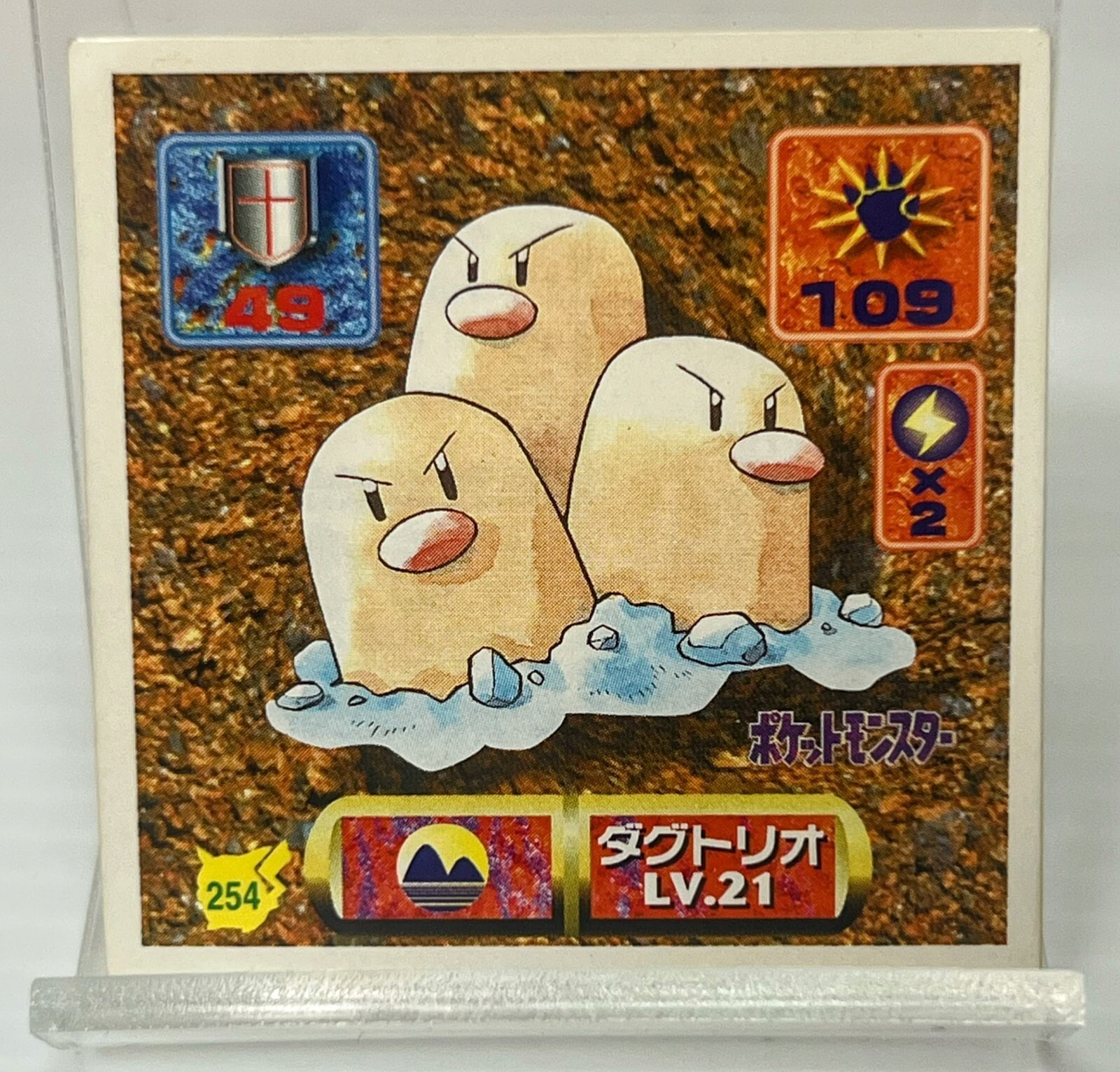
This is an Amada-brand Pokemon sticker from 1997, officially licensed by Nintendo, Creatures, and Game Freak. Amada Co., Ltd. was a Japanese toy and sticker manufacturer active from the 1960s through the 1990s, producing licensed character merchandise across anime and tokusatsu properties. This sticker belongs to a format that printed game-style stats directly on the sticker face: a shield icon for defense (49), a spike emblem for attack (109), and a double lightning bolt indicating a weakness multiplier. A red panel at lower right reads “Dugtrio / LV.21,” and the lower left pairs a Pikachu silhouette with the number 254 — this sticker’s position within its series.
The year 1997 matters here. The Pokemon anime launched on TV Tokyo that April, and this sticker was manufactured at the height of Japan’s first major Pokemon wave. The North American game release didn’t come until 1998, meaning anything produced in 1997 was designed for — and sold only in — the Japanese market. The series number 254 exceeds the first-generation count of 151 Pokemon, which in Amada’s other lines has sometimes pointed to variant printings, holographic editions, or special entries, though the exact composition of this particular series isn’t confirmed from the sticker alone.
Dugtrio: The Ground-Type Trio from Generation One
Dugtrio is National Pokedex No.51, a Ground-type Pokemon and the evolved form of Diglett. Its design — three identical heads breaking from cracked earth — gave it one of the more immediately recognizable silhouettes among the original 151. In the Game Boy titles, Dugtrio stood out for high Speed and access to powerful Ground-type moves like Earthquake, and it appeared across multiple episodes of the anime. The sticker illustration stays true to that identity, showing all three heads emerging from fractured ground. The printed LV.21 sits below the in-game evolution point (Diglett evolves at level 26), which suggests it functions as a stylistic element rather than a precise in-game reference.
Japan’s Sticker Culture and What Amada Built Within It
Sticker collecting has been part of Japanese children’s culture since at least the 1970s, and the Bikkuriman craze of the 1980s established a clear template: collectibles with both an accumulation pull and an informal competitive function. Amada’s Pokemon stickers follow that tradition directly. Sold individually or in random packs at dagashi shops, stationery stores, and supermarket toy sections — not bundled with food — they were designed so children could play informal head-to-head matches using the printed stats. Defense, attack, and weakness values on a single sticker gave each one a purpose beyond decoration, resembling a physical trading card long before the official Pokemon TCG reached Western shelves.
For collectors outside Japan, a 1997 Amada sticker occupies a specific position: it predates the global rollout, carries Japanese-language text, and belongs to a merchandise format that had no Western equivalent. Amada stickers have become a recognized sub-category within vintage Japanese Pokemon collecting, with a dedicated audience that seeks them out specifically under the “Amada sticker” label. Dugtrio, while not among the franchise’s most prominent characters, is a well-known Generation One Pokemon with consistent recognition among anyone who played the original Game Boy titles.

Found in Japan, packed by hand, sent worldwide
$8.15
Worldwide delivery from Japan • See the listing for condition and size