A Silver Metal Charmander Charm From Japan's Pokemon Boom Era

A Flat Metal Charm Built for Daily Carry
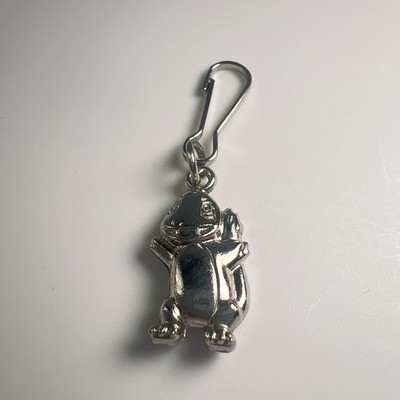
This is a small, silver-toned flat metal charm depicting Charmander, the Fire-type starter Pokemon. The character’s outline, eyes, and mouth are rendered through engraving on a reflective stamped surface — a technique common to Japanese Pokemon accessories produced in the late 1990s and early 2000s. The charm connects via a jump ring to a carabiner-style clip, the kind designed for attaching to a school bag, backpack, or keyring. That practical format places it squarely in the category of Pokemon keychain merchandise that was produced in large quantities during Japan’s original Pokemon craze.
The specific manufacturer has not been confirmed from what is visible on this piece. Major producers of Pokemon metal goods during this period included TOMY, which ran a documented “Metal Collection” series, as well as Bandai and Amada. Whether this charm was originally packaged alongside a candy product as a shokugan (food toy) prize, dispensed from a gashapon capsule vending machine, or sold individually at a toy retailer or Pokemon Center store is not established from currently available information.
Charmander: The Starter With the Burning Tail
Charmander is National Pokedex entry No. 004 and one of three starter Pokemon players could choose at the beginning of Pokemon Red and Green — the original Game Boy RPGs developed by Game Freak and published by Nintendo in Japan in February 1996. The other two starters were Bulbasaur and Squirtle. Charmander is a bipedal lizard with a flame permanently burning at the tip of its tail; the anime, which launched on TV Tokyo in April 1997, made memorable use of the idea that if that flame goes out, the Pokemon’s life is in danger. That story beat stayed with audiences and contributed significantly to the character’s lasting popularity.
Charmander evolves into Charmeleon at level 16, then into Charizard at level 36. Charizard — Fire and Flying type, with a wingspan and silhouette reminiscent of a dragon — became one of the most recognized Pokemon in the franchise. The evolutionary line carries particular appeal among collectors who grew up with the original 151. The pose shown on this charm, a relaxed upright stance with arms slightly raised, matches the standard Charmander artwork used on trading cards and official materials from the 1990s.
The Era When Japanese Pokemon Merchandise Peaked
Between roughly 1997 and 2001, Japan experienced a Pokemon merchandise boom that touched nearly every category of consumer goods. Games, the anime, films, trading cards, and physical accessories all reinforced one another, and metal charms were a small but durable corner of that market. The carabiner-clip format was itself a fashionable accessory type in Japanese youth culture during the late 1990s and early 2000s, and Pokemon-branded versions were widely available. Metal construction gave these pieces a practical advantage over paper or vinyl alternatives: the stamped and engraved surface resists wear and holds detail well, so examples from this period often survive in recognizable shape.
For collectors outside Japan, merchandise from this initial domestic wave carries a distinct historical character. North America and Europe began receiving Pokemon in 1998 and 1999, meaning the Japanese market produced its first generation of goods well ahead of the international rollout. Items like this charm represent the earliest commercial expression of a franchise that went on to become one of the most widely recognized in the world.


Shipped directly from Japan by a small shop
$14.07
Ships worldwide from Japan • Full photos and details on the listing