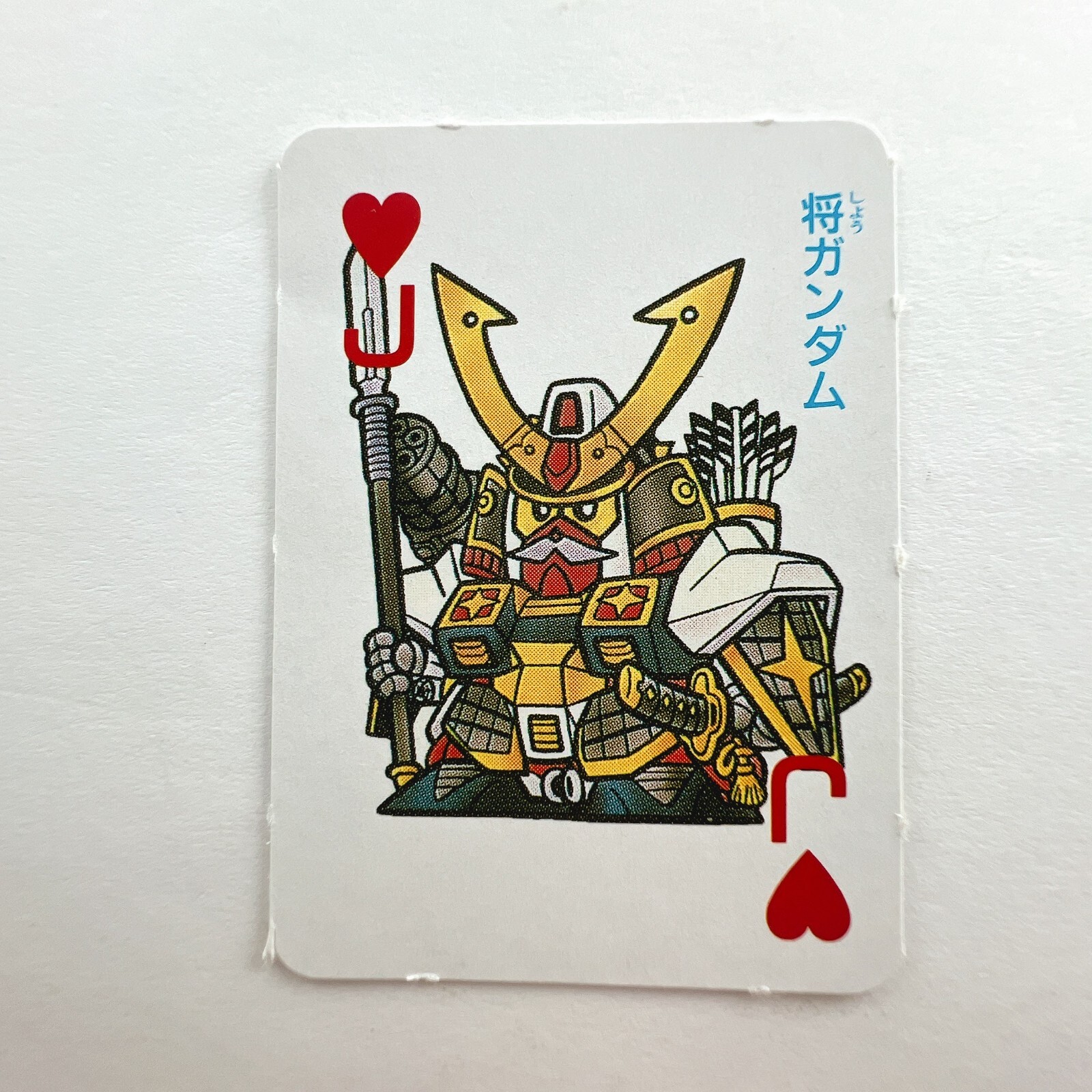
Sho Gundam SD Gundam Playing Card, Comic BomBom February 1990 Supplement

Sho Gundam and the SD Sengoku Den Universe
This card features Sho Gundam, a character from the SD Sengoku Den sub-series — one of the most distinctive branches of Bandai’s SD Gundam (Super Deformed Gundam) franchise. SD Gundam itself emerged around 1985–1986 as a spin-off of the original Mobile Suit Gundam anime (1979, dir. Yoshiyuki Tomino), redesigning the series’ iconic mechanical suits with exaggerated chibi proportions: large heads, compact bodies, and an overall playful quality distinct from the parent series.
SD Sengoku Den, which began around 1987, pushed that concept into feudal Japan. Characters in the sub-series wear samurai armor, crested helmets, and carry traditional weapons — Gundam units reimagined as warrior-class figures from Japan’s Sengoku period. Sho Gundam fits this mold precisely. The name itself uses the kanji “将” (sho), a title meaning general or commander, denoting high military rank. The character is depicted with samurai armor, a V-fin helmet crest, a spear, and a quiver — all standard visual language for the warrior-type figures within this series. The card is the Jack of Hearts in a standard 52-card playing card format.
Born as a Manga Magazine Bonus
Comic BomBom was a monthly boys’ manga magazine published by Kodansha from 1981 to 2007, and one of the primary venues for SD Gundam manga content — including serializations such as SD Gundam Gaiden. Alongside Shogakukan’s Corocoro Comic, it defined boys’ manga publishing in Japan through the 1980s and 1990s.
The February 1990 issue is when this card reached readers, a moment when SD Gundam was near its domestic popularity peak, partly driven by the success of Bandai’s BB Senshi plastic model line launched in 1988. Supplements were central to how manga magazines competed for readers: playing cards, stickers, desk mats, and mini card games were packaged with specific issues as purchase incentives. Because production quantities were tied to the magazine’s print run, and distribution was limited to readers of that issue, these items never circulated as standalone retail products. The visible halftone dot printing on the card is characteristic of Japanese print production from this era, giving it a texture closely associated with the late Showa and early Heisei years.
What Draws Collectors to This Kind of Item
SD Gundam has a recognized following in parts of Asia, North America, and Europe, particularly among collectors of the BB Senshi model kit line. Within that community, the SD Sengoku Den characters occupy a distinctive space: the fusion of feudal Japanese warrior design with robot aesthetics reads as particularly Japanese in a way that broader Gundam merchandise does not always convey. For collectors outside Japan, that combination carries specific visual appeal.
Comic BomBom was a Japan-domestic publication and its supplements had no official international distribution. Items like this card entered circulation only through readers who purchased that specific issue at the time — which means they have no retail history abroad. The playing card format is also somewhat unusual in the Gundam collectibles landscape, where plastic models, gashapon, and figures dominate. Whether the full deck featured an assortment of SD Gundam characters across all 52 cards cannot be confirmed from available information, but the format itself places this item in a different category from the merchandise most collectors encounter.


Shipped directly from Japan by a small shop
$8.82
Ships worldwide from Japan • Full photos and details on the listing