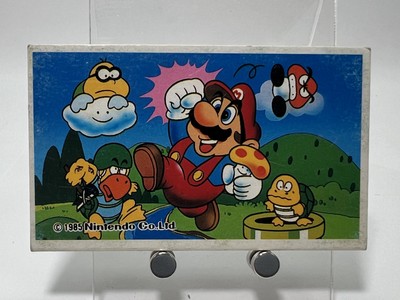
Super Mario Bros. Menko Card by Amada, Nintendo Licensed, 1985 — Card #17

A Traditional Japanese Card From the Dawn of the Mario Franchise
This card is a menko — a flat, rectangular piece of thick cardboard rooted in a Japanese children’s game that predates the modern era by centuries. Unlike Western trading cards, menko were designed to be played physically: a player slaps their card onto a hard surface, and the resulting air pressure or impact flips an opponent’s card over, winning it. By the 1970s and 80s, manufacturers were printing licensed character artwork on them and selling individual cards for just a few yen apiece at dagashi-ya — the small neighborhood candy-and-toy shops that were a fixture of Japanese childhood. Because the cards were cheap, plentiful, and actually played with, well-preserved examples are comparatively scarce today.
This card carries a © 1985 Nintendo Co. Ltd copyright notice, placing it squarely in the year Super Mario Bros. launched on the Famicom — the home console Nintendo released in Japan in July 1983. Super Mario Bros. debuted on September 13, 1985, developed by Shigeru Miyamoto, and it became one of the defining titles in video game history, helping revive the home console market after the industry downturn of the early 1980s. Merchandise tied to the game began appearing almost immediately in Japan, and this menko belongs to that first wave of licensed goods.
The Characters on the Card and the World They Come From
Mario himself is depicted holding a mushroom — a direct reference to the Super Mushroom power-up that transforms him into Super Mario in the game. Several of the franchise’s signature enemies also appear: Lakitu (Jugemu in Japanese), the cloud-riding foe who drops Spinies from above; Koopa Troopa (Nokonoko), the turtle-shelled enemy that emerges from pipes; and Paratroopa (Patapata), the winged, red-colored variant that flies through the air. One additional figure — described as a green-helmeted, duck-like enemy — does not map cleanly onto any confirmed in-game character from the 1985 release. Licensed merchandise of this era sometimes featured artwork where illustrators took creative liberties with the source material, so this character is most likely a stylized interpretation of an existing enemy rather than a direct correspondence.
Amada, the Famicom Boom, and What Makes This Format Distinct
The card was produced by Amada, a Japanese manufacturer that held licenses from Nintendo and many other major IP owners throughout the 1980s and 90s, producing menko, stickers, and card sets tied to franchises including Dragon Ball, Saint Seiya, and Kamen Rider. The AMADA name was a familiar presence in dagashi-ya, and the company’s Nintendo-licensed output spanned multiple series and formats during the Famicom’s peak years.
The series number #17 printed on this card confirms it belongs to a larger set, though the full count of cards in the series cannot be determined from this card alone. For collectors interested in early Nintendo merchandise, the menko format carries a specific cultural weight: it is a genuinely Japanese form with no Western equivalent, sold exclusively in the domestic market, illustrated by hand in a pre-digital commercial style, and tied directly to the year the Mario franchise launched. It is a small but concrete artifact from the moment a global phenomenon was just beginning.

Shipped from Japan, tested where noted in the listing
$8.82
Worldwide delivery from Japan • See the listing for condition and size