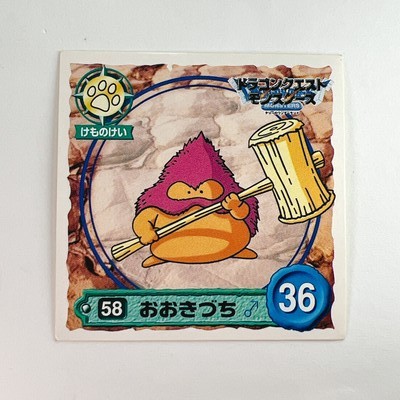
Hammerhood #058 — Official Dragon Quest Monsters Sticker by Enix, 1998

A Single Sticker from a Monster-Collecting Phenomenon
This is an official character sticker released by Enix in 1998 alongside Dragon Quest Monsters: Terry’s Wonderland — the company’s spin-off RPG for the Game Boy Color. The number 058 on the sticker matches Hammerhood’s position in the game’s monster encyclopedia; a secondary number (36, enclosed in a blue circle) appears to track the sticker’s own place within the wider series. The artwork reflects the official game illustration style.
Dragon Quest Monsters launched on September 25, 1998, as a spin-off from the Dragon Quest series, which Enix had been publishing since 1986. Where the mainline games pit players against monsters, DQM builds its system around capturing, raising, and breeding them — a design aimed at the same audience drawn to Nintendo’s Pokemon. The protagonist is a young version of Terry, a character from Dragon Quest VI. The game reached North America in 2001 under the title Dragon Warrior Monsters, giving the franchise an international footprint that extends to its merchandise.
Hammerhood in the DQM Bestiary
Hammerhood — Ookidzuchi in Japanese, meaning roughly “great wooden mallet” — is monster #058 among the 215 creatures in Dragon Quest Monsters, classified under the Beast type. The paw-print emblem in the sticker’s upper-left corner indicates that classification, matching the game’s own interface design. The creature’s look is exactly what the name describes: a purple-hooded head, an orange body, and an oversized wooden hammer. Name and design say the same thing, with no gap between them.
Every monster in Dragon Quest Monsters was designed by Akira Toriyama (1955–2024), and Hammerhood is a clear example of his direct, legible approach to character design. Toriyama’s death in March 2024 drew renewed worldwide attention to everything he created for Dragon Quest and Dragon Ball, which is why his name appears prominently in how these items are described to international collectors.
Japan’s Game Sticker Culture and Where This Item Fits
Collectible character stickers formed their own consumer market in Japan through the 1980s and 1990s. The Bikkuriman sticker series, launched by the confectionery company Lotte in 1987, established the format: small character sheets sold individually or in random packs and collected into albums by children who might not otherwise own the games or toys the characters came from. Game companies including Enix followed the model for their own franchises. Whether this specific sticker was manufactured by Enix directly or by a licensed producer — some Dragon Quest stickers from the period were made by specialist companies like Amada under Enix supervision, though the production details for this item are unconfirmed — the artwork is official and the item belongs to this tradition of game-character paper goods that preceded the trading card era.
Enix merged with Square in 2003 to form Square Enix, ending the Enix name as an independent label. Items bearing the Enix imprint, like this 1998 sticker, belong entirely to the pre-merger period. The Dragon Quest Monsters series has continued into the present — a 2023 entry is the most recent installment — but this sticker is a document of the franchise’s early years, the peak of Japan’s game sticker culture, and a company that no longer exists under its original name.


Shipped directly from Japan by a small shop
$8.15
Ships worldwide from Japan • Full photos and details on the listing