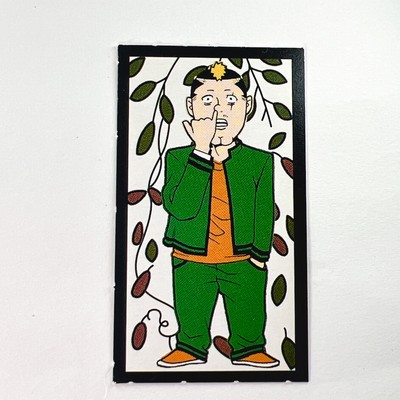
Nendou Riki Jump Hanafuda Card — Saiki Kusuo no Psi-nan (2018)

A Traditional Game, Reimagined for Shonen Jump
Hanafuda — literally “flower cards” — is one of Japan’s oldest card games, with roots going back to card games introduced by Portuguese traders in the sixteenth century. A complete deck contains 48 cards across twelve suits, one for each month of the year, each defined by a seasonal plant: pine for January, plum for February, cherry blossom for March, and so on. The cards are compact, densely illustrated, and have been part of Japanese domestic life for centuries.
Jump Hanafuda takes that structure and replaces the traditional botanical imagery with characters from Weekly Shonen Jump. The original plant motifs remain visible in the background — green and brown foliage runs through each card’s design — but the focal point becomes a manga character illustrated in their series’ style. The result is a set that functions as a traditional game while also serving as franchise art. IP-collaboration playing cards of this kind have become a well-established category in Japan, applied to game, anime, and manga properties across numerous titles.
This card was produced in 2018, a year that carried particular weight for Weekly Shonen Jump: the magazine launched in 1968, making 2018 its fiftieth anniversary, and Shueisha marked that milestone with a wide range of commemorative merchandise. Jump Hanafuda fits naturally into that context, though a confirmed tie to the anniversary program specifically has not been established for this set. Jump Hanafuda has appeared in multiple editions over the years, with the lineup of featured series varying between versions. The card’s connection to the weekly magazine — whether as a supplement, a tie-in item, or something announced through its pages — is indicated by the listing but not described in further detail.
Nendou Riki and Why He Matters in Saiki K.
The character on this card is Nendou Riki, one of the principal supporting figures in Saiki Kusuo no Psi-nan — released internationally as The Disastrous Life of Saiki K. The manga, written and drawn by Asou Shuuichi, appeared in Weekly Shonen Jump from 2012 through early 2018, concluding at 26 collected volumes. An anime adaptation produced by J.C.STAFF aired in two cours across 2016 and 2017, followed by a live-action film in October 2017. The series is available internationally through Netflix and has built a substantial audience in English-speaking countries under the Saiki K. name.
The story’s premise turns on irony: the main character, Saiki Kusuo, possesses nearly every psychic ability imaginable — telekinesis, telepathy, time-stop, clairvoyance — and wants only to be left alone. Nendou is the person who makes that impossible. His appearance follows a classic manga delinquent template: a pompadour hairstyle, an imposing face, a star mark on his forehead, and lightning-bolt markings around his eyes. In practice he is relentlessly cheerful, intensely loyal, and almost entirely oblivious to how others see him.
What gives Nendou a structural role beyond comedy is the fact that his thinking is so direct and uncomplicated that Saiki’s telepathy finds no purchase in it. He is the one person in Saiki’s world the protagonist genuinely cannot read, which keeps him a permanent fixture of the story despite Saiki’s best efforts. The nose-picking gesture shown on this card is one of Nendou’s most repeated visual gags throughout the series — a small, completely unself-conscious act that captures the character precisely. Among international fan communities, Nendou is one of the most recognized figures from the series, appearing frequently in fan art and online discussion. Seeing that gesture translated into the format of a traditional hanafuda card, against centuries-old botanical motifs, places a very familiar character in a context that rarely makes it outside Japan.


Found in Japan, packed by hand, sent worldwide
$11.95
Worldwide delivery from Japan • See the listing for condition and size