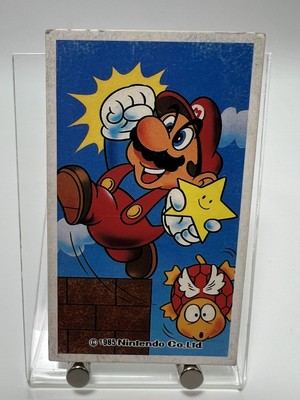
Amada Super Mario Bros. Menko Card No. 48 (1985)

Japan’s Menko Tradition
Menko are a form of card toy with roots stretching back to Japan’s Edo period. Originally made from lead or clay, by the Showa era they had settled into a familiar form: stiff rectangular or round cards made from paper or cardboard, printed with colorful imagery on one side. The game is competitive — players slam their cards against the ground, using the resulting air pressure or impact to flip an opponent’s card; whoever flips it wins it. Simple and physical, menko were a staple of the dagashi-ya, Japan’s small cheap-snack-and-toy shops that defined postwar childhood.
By the 1980s, the appeal had expanded well beyond the playing of it. Character menko — printed with anime heroes, tokusatsu figures, sports stars, and video game characters — had become as much a collecting pursuit as a competitive one. Kids gathered sets the way other generations gathered baseball cards, and manufacturers like Amada produced numbered series across multiple franchises to meet that demand.
The Franchise This Card Was Born Into
Super Mario Bros. launched on the Famicom — Nintendo’s Family Computer console — on July 25, 1985. The side-scrolling platform game put Mario, a plumber previously known only from the 1981 Donkey Kong arcade cabinet (where he went by Jumpman), at the center of his own franchise for the first time. By the end of that year, the game was expanding into North America on the NES, and a global franchise was underway.
The copyright mark on this card, © 1985 Nintendo Co., Ltd., aligns exactly with that launch year, placing it among the earliest licensed merchandise to carry the Super Mario Bros. brand. Amada, a Japanese toy and character-goods manufacturer active from the 1970s through the 1990s, held an official Nintendo license during the Famicom era and produced menko covering Mario and other major titles of the period. The card’s designation as #48 in a numbered series indicates it was part of a structured set, though complete records of that series’ full scope have not been widely documented.
What the Illustration Shows
The image places Mario mid-air — red cap, blue overalls — one fist extended in a punch, a Super Star held in his hand. The Super Star, a yellow five-pointed power-up that grants brief invincibility when collected, has remained one of the franchise’s most recognizable visual symbols. Also depicted is a Paratroopa (Patapata in Japanese), the winged variant of the Koopa Troopa enemy that flies or hops through the game’s levels; knock one from the air and it loses its wings, reverting to a standard Koopa. Blue sky, clouds, and brick blocks fill the background — the foundational visual vocabulary of the Mushroom Kingdom as players first encountered it.
This is official artwork from the period when Nintendo and its licensees were communicating the game’s world to Japanese children for the very first time. The character styling reflects how Mario looked in the mid-1980s, before the globally consistent design that emerged in later decades, making this card a visual record of the franchise at its earliest point.

Shipped from Japan, tested where noted in the listing
$7.86
Ships internationally • More photos on the eBay listing