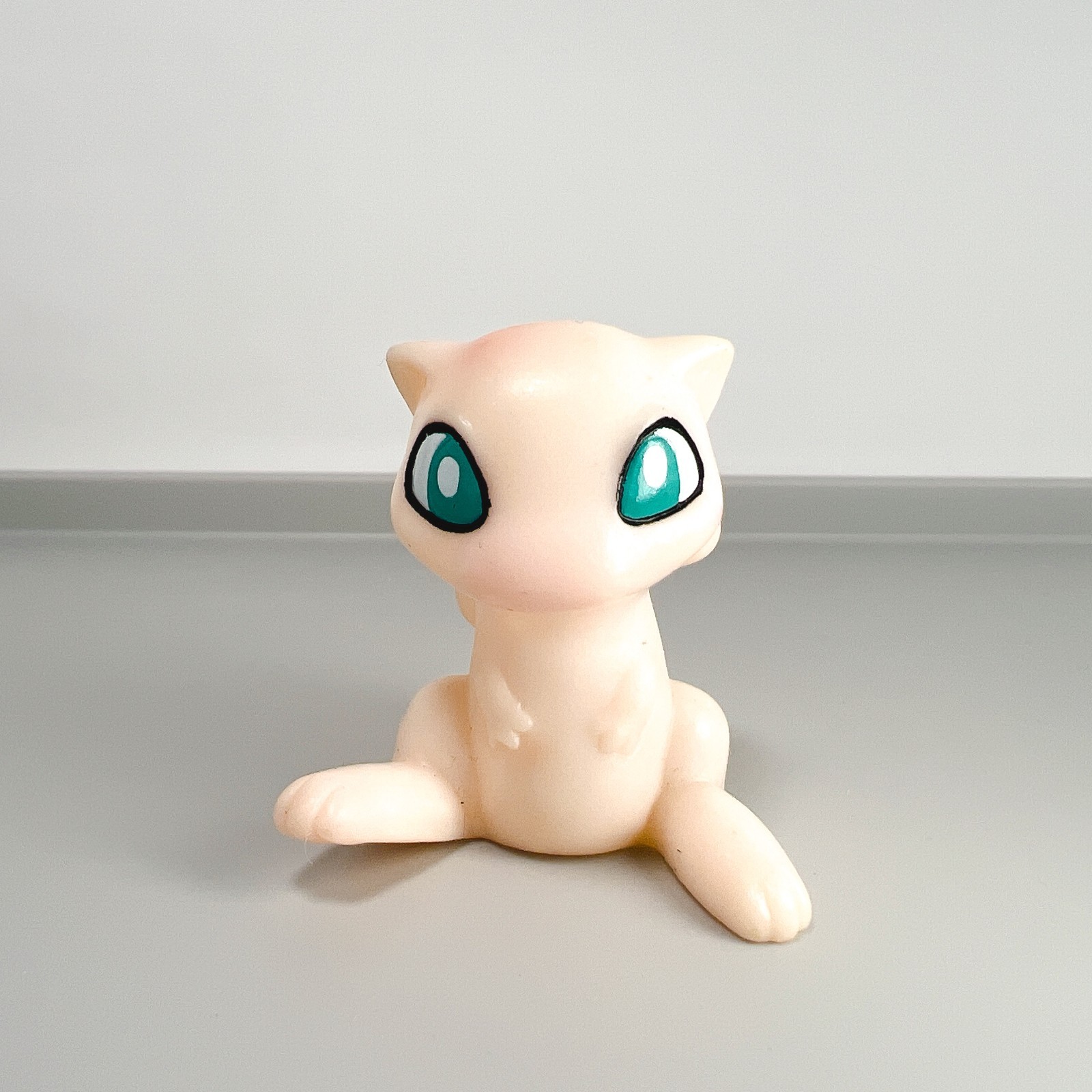
Mew Pokemon Kids Sofubi Figure by Bandai, 1996

A Sofubi Food-Toy From Japan’s Pokemon Dawn
This figure belongs to Bandai’s Pokemon Kids line — a shokugan product, meaning it was sold packaged with a small candy or gum. Shokugan (food-toy) items were a fixture of Japanese childhood: priced low enough for pocket money and sold through candy shops, supermarket candy aisles, and stationery stores across the country.
The figure itself is a sofubi, short for soft vinyl — a flexible plastic material that has been central to Japanese toy culture since the kaiju and hero figures of the 1950s and 60s. Bandai has a long manufacturing history with this material, well before their involvement with Pokemon. Sofubi favors a clean silhouette over fine surface detail, and the result is a softer, slightly pliable object with a distinct character that sits apart from the rigid, highly refined PVC figures that dominate the modern collectibles market.
The Pokemon Kids line launched in close step with the franchise itself in 1996, though the precise release date of the first wave varies slightly across sources. Whether this figure’s 1996 date refers to the year of manufacture or the year of first sale is something best confirmed by the stamp on the base, where Bandai typically included copyright and production markings.
Mew: The Hidden Pokemon at the Heart of Generation One
Pocket Monsters Red and Green launched in Japan on February 26, 1996, the starting point of what would become one of the most expansive media franchises in history. Mew holds Pokedex number 151 — the final slot in the original lineup — and occupies an unusual position even within that group. The character was built into the games as an inaccessible hidden Pokemon, reportedly added late in development; multiple accounts of how it came to be included have been told over the years, and the details vary depending on the source.
From launch, rumors of a 151st Pokemon spread among children, and Mew quickly took on a mythological quality. By 1998, when the first Pokemon film centered its plot on Mew as the genetic original from which Mewtwo was derived, that reputation was formally embedded in the franchise’s canon. Mew’s design — small, bipedal, pale pink, with large turquoise eyes and triangular ears — is one of the franchise’s most recognizable silhouettes, and this figure’s coloring directly matches that established look.
A Japan-Exclusive Format With a Global Fanbase
Pokemon Kids figures were standard retail products in Japan at the time of release — everyday items sold alongside candy in general stores. The line was never officially distributed in North America or Europe, which means international fans have always needed to source them directly from Japan through import channels or auction platforms. They remain a Japan-exclusive category in practice, even though they were originally mass-market goods domestically.
Pokemon has since grown into one of the highest-grossing media franchises in the world by total sales across multiple measures. Within the international collector community, first-generation characters — and Mew in particular, given its narrative weight and “legendary” in-game status — carry strong recognition. The combination of Japan-exclusive distribution, a character with deep franchise symbolism, and a production period tied to the franchise’s founding year places this figure in a specific context within Gen 1 Pokemon collecting. Separately, there is an active community of collectors who value sofubi as a format in its own right, distinct from later PVC figures, for its retro texture and silhouette-first approach to form.


Boxed and cushioned for the trip from Japan
$18.85
Worldwide delivery from Japan • See the listing for condition and size