Kamen Rider Showa-Era Menko Card with Silver Frame
Menko: Japan’s Traditional Paper Toy Cards
Menko are flat paper cards — typically rectangular or circular — that Japanese children collected and played with across the postwar Showa decades. The game involves slapping a card onto the ground hard enough to flip an opponent’s; its origins trace back to the Edo period, though the format reached its commercial peak in the 1950s through 1970s, when printers mass-produced cards bearing baseball players, sumo wrestlers, anime heroes, and tokusatsu characters.
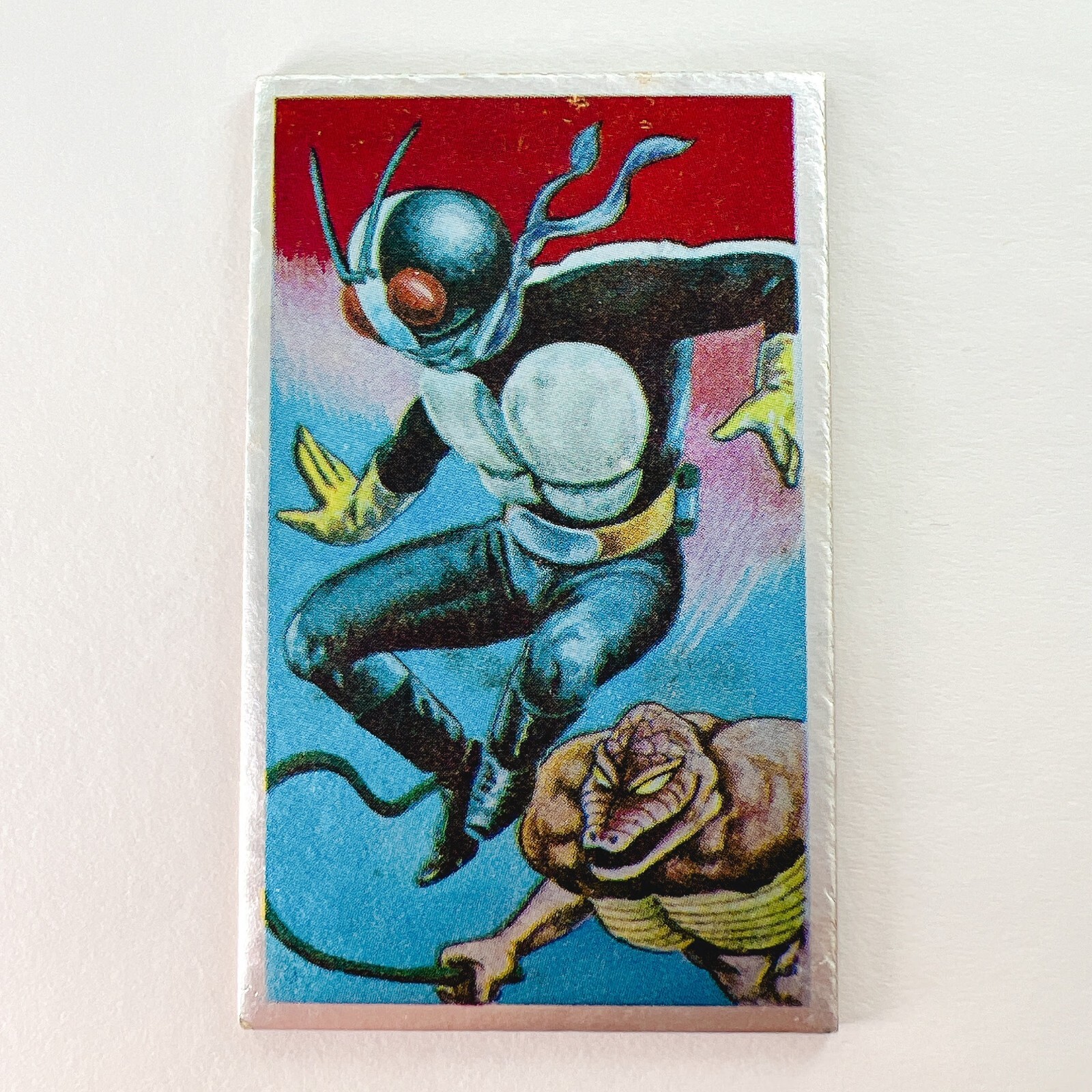
This card is rectangular with a silver border and printed in color. The fine dot texture visible across the image is characteristic of offset printing as it was practiced in the 1960s and 1970s, and the overall design places it within the Showa-era production window of roughly 1971–1979. Menko of this period were sold individually or bundled at dagashi-ya — the penny candy shops that anchored neighborhood childhood economies — and at festival stalls. They were everyday pocket-money items, not premium releases. By the 1980s the format was largely displaced by trading cards and home video games, and original Showa-era pieces now occupy their own distinct niche in Japanese paper collectibles.
Kamen Rider and the World It Comes From
Kamen Rider premiered on MBS/TBS in April 1971 and ran for 98 episodes, produced by Toei from a concept by manga artist Shotaro Ishinomori. The story centers on Takeshi Hongo, a young man surgically altered by the criminal organization Shocker who escapes before his brainwashing is complete and turns his grasshopper-based cyborg abilities against them. The blend of motorcycle action, transformation sequences, and imaginatively costumed kaijin (monster) designs made it a cultural phenomenon — and triggered the first major wave of Kamen Rider merchandise, menko included.
The figure on this card is consistent with Kamen Rider 1, identifiable by the antennae, red compound eyes, and the black-and-white insect-cyborg suit that defined Ishinomori’s original design. The opposing character appears to be a reptilian Shocker kaijin, though the specific name cannot be confirmed from the card alone. It is worth noting that distinguishing Rider 1 from Rider 2 — who joined the series partway through its run — can be genuinely difficult from card imagery, so that identification carries some uncertainty. No manufacturer markings are visible, which was common: the menko market involved both licensed and unlicensed producers, from established toy companies to small regional print shops, and attribution is often impossible to establish from the card face alone.
The original series launched a Showa Rider lineage that continued through V3, X, Amazon, Stronger, and beyond — each new entry generating its own wave of menko and related paper goods. The franchise has continued uninterrupted into the Heisei and Reiwa eras and remains one of Toei’s flagship properties more than fifty years on.
Why This Subject Resonates With International Collectors
Kamen Rider has a documented international footprint. The franchise has been broadcast or adapted across the United States, Southeast Asia, Latin America, and Europe — Saban’s American version, “Masked Rider,” aired in 1995. Collectors who encountered the franchise through regional adaptations, or who arrived via the broader tokusatsu fandom surrounding Ultraman and Godzilla, often seek out original Showa merchandise as a tangible connection to the source material and its era.
The menko format adds a cultural dimension that standard trading cards do not carry. There is no Western equivalent to the menko game and its dagashi-ya ecosystem, which makes these cards a distinctly Japanese artifact. For collectors drawn to 1970s Japanese pop culture — whether through tokusatsu, kaijin design, or Showa-era print aesthetics — a card like this represents a direct physical link to the moment when Kamen Rider first captured the imagination of a generation of Japanese children.


Shipped directly from Japan by a small shop
$13.11
Ships worldwide from Japan • Full photos and details on the listing