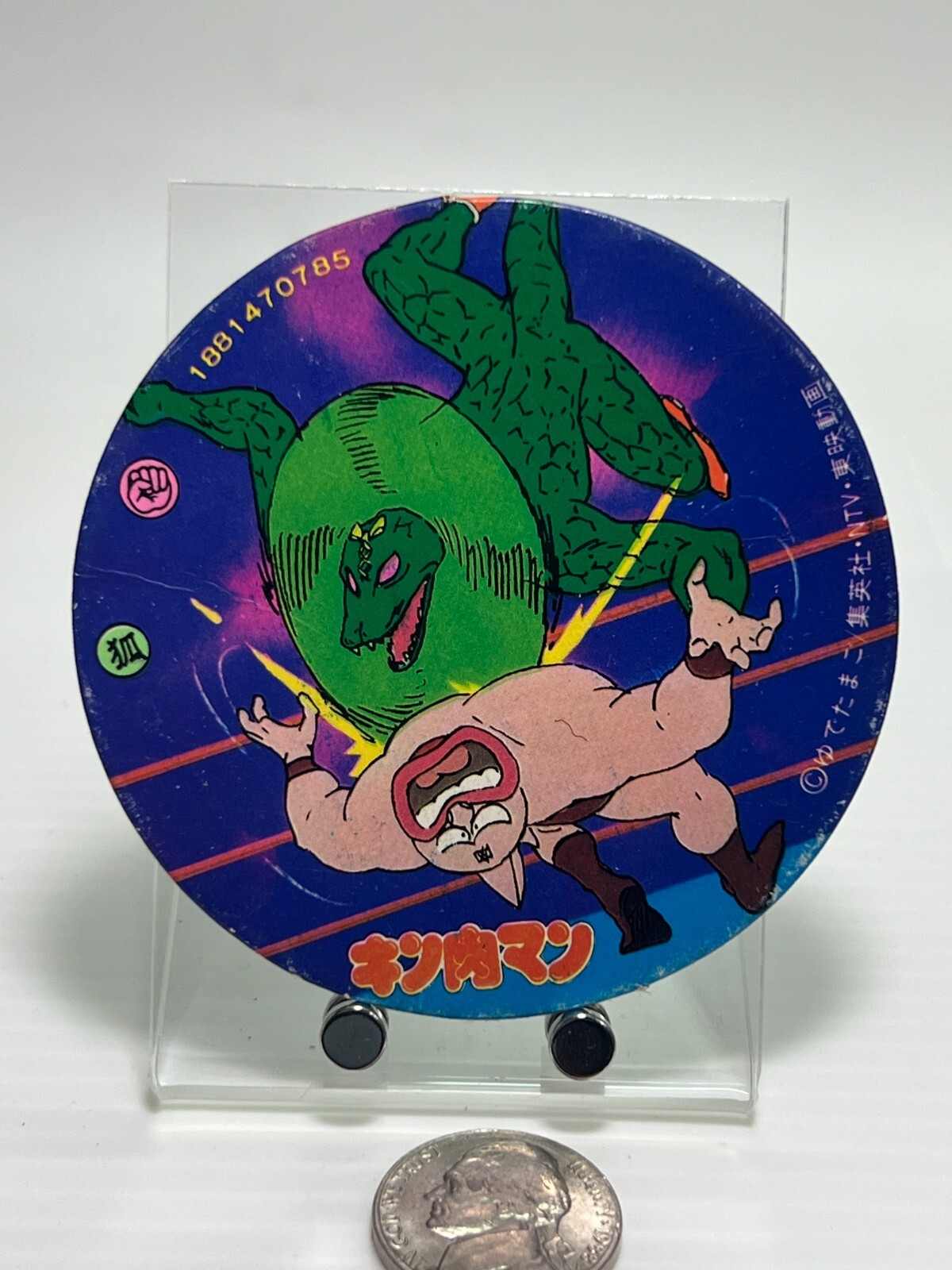
Kinnikuman Circle Menko Card from 1980s Japan

Menko: Japan’s Original Cardboard Battle Game
Menko is a traditional Japanese children’s game with roots stretching back to the Edo period. The concept is simple: players take turns slapping their cards onto a hard surface and try to flip their opponent’s card face-up through the impact and rush of air. Circular menko — like this card — were one of the most widespread formats, produced alongside rectangular versions throughout the twentieth century.
By the 1980s, the traditional format had evolved into “character menko,” mass-produced cards featuring popular anime and manga figures sold for just a few yen at dagashiya — the small neighborhood candy-and-toy shops that were central to postwar Japanese childhood. Before trading card games as we know them today, menko was the accessible, street-level card game for an entire generation of Japanese kids, widely regarded as a direct precursor to the TCG boom that followed.
Kinnikuman and the Anime Boom Behind This Card
Kinnikuman began as a manga by the creative duo Yudetamago — the pen name of Yoshinori Nakai and Takashi Shimada — launching in Shueisha’s Weekly Shonen Jump in 1979. The story follows Suguru Kinniku, a comically designed alien wrestler with pink skin and a signature mask, through a blend of gag humor and increasingly intense battles against a large cast of rival Chojin, or super-beings. The series was one of the defining franchises of the Jump golden age, and a massive wave of licensed merchandise followed in its wake.
The anime adaptation aired on NTV from 1983 to 1986, produced by Toei Animation, and it was during this broadcast window that character goods — menko included — flooded the market. The copyright line on this card credits Yudetamago, Shueisha, NTV, and Toei Animation, reflecting the official rights structure of the production and confirming this is an authorized licensed item.
The card depicts Kinnikuman alongside what appears to be a large green reptilian figure. The series introduced dozens of creature-type Chojin rivals across its run, and a precise identification of this particular opponent from the card image alone is difficult to confirm. The pink fist icon and the symbol inside the green circle on the card’s left side most likely functioned as game-mechanic markers indicating strength or elemental type — a convention standard to menko of this era.
A Card That Connects Two Generations of Fans
For collectors outside Japan, Kinnikuman already carries a built-in point of recognition. Between 1985 and 1987, Mattel brought the franchise to North American toy shelves as M.U.S.C.L.E. — Millions of Unusual Small Creatures Lurking Everywhere — a line of small flesh-colored wrestling figures that introduced the characters to Western children who had no idea their source was a Japanese manga and anime.
Beyond the franchise itself, menko represent a format that simply does not exist outside Japan: official anime art printed on circular cardboard game pieces, once sold for pocket change at candy shops. The format predates modern trading cards by centuries in its traditional form, with 1980s anime imagery as the era’s distinct layer on top of that longer history. Cards like this one now circulate as artifacts of the Showa period — drawing interest from fans of vintage anime, enthusiasts of Japanese street culture, and collectors focused on officially licensed goods from the original broadcast era.

Listed in our eBay store and sent from Japan
$8.15
International shipping available • Ask us anything before you buy