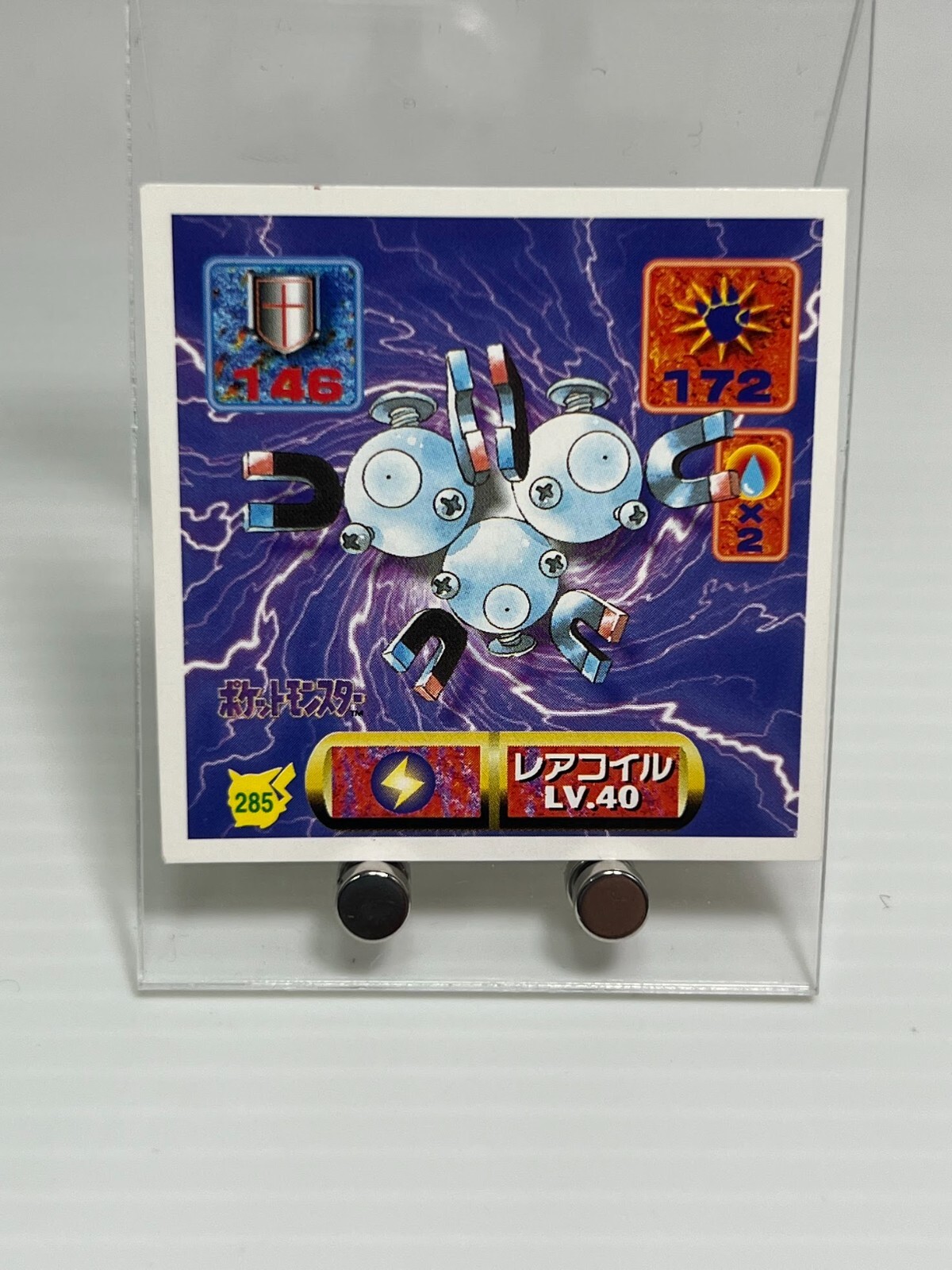
Magneton Pokemon Sticker No.285 by Amada (1997): A First-Generation Collectible from Japan's Pokemon Boom

What This Sticker Is
This is a single paper sticker — likely gloss-finished — produced by Japanese manufacturer Amada in 1997, featuring Magneton (known in Japan as Rarecoil), Pokedex number 082. The sticker carries the series number No.285, which is Amada’s own sequential numbering within this Pokemon sticker line, not Magneton’s national Pokedex entry. Its rectangular format closely mirrors the layout of a trading card: numerical values in the upper area (possibly representing stats such as level or HP), and symbols indicating type matchups — a red-cross shield suggesting a weakness, a water-drop marked “×2,” and similar shorthand that directly echoes the Pokemon Trading Card Game’s design language. A Pikachu silhouette mark along the lower edge serves as a series identifier consistent across Amada’s Pokemon sticker releases. The item is a sticker, not a card — a deliberately different format that borrows TCG visual vocabulary.
The Character and the Era It Comes From
Magneton is an Electric-type Pokemon from the original 151 — the first generation introduced in the 1996 Game Boy titles Pokemon Red and Green. Its design concept is straightforward and memorable: three Magnemite units fused into a single entity, each sphere fitted with a Phillips-head screw on top and a horseshoe magnet on the side. That fusion-and-magnetism premise made Magneton a recurring presence in game storylines involving electronics and magnetic fields. The purple background and white lightning bolt on this sticker reflect the color coding Amada applied consistently across its Electric-type entries in the series.
The year 1997 is significant. The Pokemon anime began airing in Japan in April of that year, triggering a rapid expansion of the merchandise market. Amada — a well-established Japanese licensed goods producer known for sticker, card, and menko sets tied to Dragon Ball, Sailor Moon, and other major anime IPs — was actively issuing multiple Pokemon sticker series during this period. The fact that this entry reaches number 285 in its sequence indicates the scale of Amada’s Pokemon output at the time. These stickers were sold widely through toy shops, corner candy stores (dagashiya), and supermarket toy sections; some Amada products also circulated through capsule-toy vending machines, though the exact retail format for this specific item isn’t confirmed.
Why Collectors Around the World Take Interest
Items manufactured in Japan in 1997 occupy a specific place in Pokemon collecting: they predate the franchise’s international rollout (North America and Europe from 1999 onward), making them part of the earliest wave of officially licensed Pokemon merchandise. The all-Japanese text — including the character name, stat labels, and type notations — marks this clearly as a domestic Japanese product from that founding period, which carries its own context for collectors who track the franchise’s origins. Amada’s name is recognized within the international Pokemon collecting community as a producer of legitimate, licensed early-era goods. Magneton itself is an original-151 Pokemon with an unbroken presence across games and animated media from 1996 onward, and later received an additional evolution (Magnezone) in the fourth generation in 2006 — a continuity that keeps first-generation Magneton merchandise relevant across collector generations.

Price: $7.67 | View on eBay

