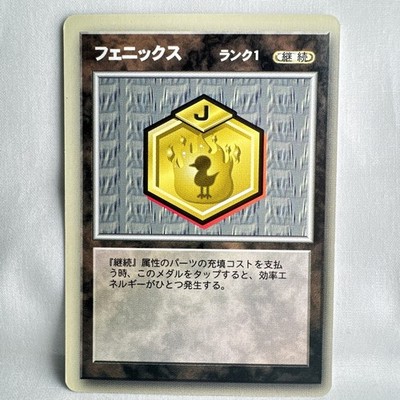
Medarot Phoenix Medal Card

A Medal Card at the Heart of the Medarot Game System
The Medarot trading card game used a distinct card type called the Medal Card to represent the “Medal” — the core component of every Medarot robot. In the lore and gameplay of the franchise, the Medal is the soul and personality of a Medarot; without it, the robot is just inert hardware. On the card game level, the Phoenix Medal Card carries a Rank 1 designation and is associated with the “continuous” attribute, giving it the ability to generate energy efficiently during the charge phase of battle.
Visually, the card is finished with holographic foil treatment across its background — a technique that served as standard shorthand for rarity across Japanese TCGs of the late 1990s. The illustration shows a young bird engulfed in flames, drawing directly from the classic rebirth imagery of the phoenix myth. A letter “J” also appears on the medal illustration; its precise role in the card game’s notation system is not entirely certain, but it likely marks a classification or ranking category within the game’s framework. The card’s text is entirely in Japanese, as it was produced for the domestic Japanese market.
Medarot, Imagineer, and Japan’s Monster-Battle Card Boom
The Medarot franchise was created and developed by Imagineer, launching as a Game Boy RPG series in Japan in 1997. Its premise revolves around combining a Medal with interchangeable mechanical parts to build a custom robot — a Medarot — and battling opponents in contests known as Robottles. The franchise reached its commercial peak around 1999 to 2000, when a television anime series produced by Tatsunoko Production began airing on TV Tokyo, alongside the release of Medarot 2 for Game Boy. The two properties reinforced each other and defined the high point of the franchise.
This period was also the height of Japan’s character TCG boom, sparked largely by the success of the Pokemon Trading Card Game from 1996 onward. Numerous anime and game franchises launched their own card games during this window, and the Medarot card game fits squarely into that pattern. Bandai, which has a documented history of producing Medarot-related merchandise, is believed to have manufactured the cards under license from Imagineer — though the precise credit is best confirmed from the card’s own printed text.
Phoenix Lore, International Recognition, and the Collector Context
The phoenix is an established design within the Medarot series, appearing across both the games and the anime with associations tied to flame, regeneration, and endurance — attributes that align naturally with the “continuous” mechanics of this card. The illustration of a flame-wrapped chick draws from mythological imagery that carries recognition well beyond the franchise itself, giving the card appeal even to collectors who have no prior connection to Medarot.
Outside Japan, the franchise was exported as Medabots, with the anime reaching North American audiences around 2001. That broadcast left a lasting impression on viewers who are now in their thirties and forties. The Japanese card game, however, was never localized or released internationally, meaning cards like this one circulated only within Japan during the game’s active period. The Medarot trading card game has since been discontinued, and surviving cards now trade exclusively through the collector and secondary market.


Sleeved and rigid-mailed before it leaves Japan
$8.82
Ships worldwide from Japan • Full photos and details on the listing