1985 Ninja Jajamaru-kun Menko Card by JALECO

A Cardboard Relic from Japan’s Famicom Golden Age
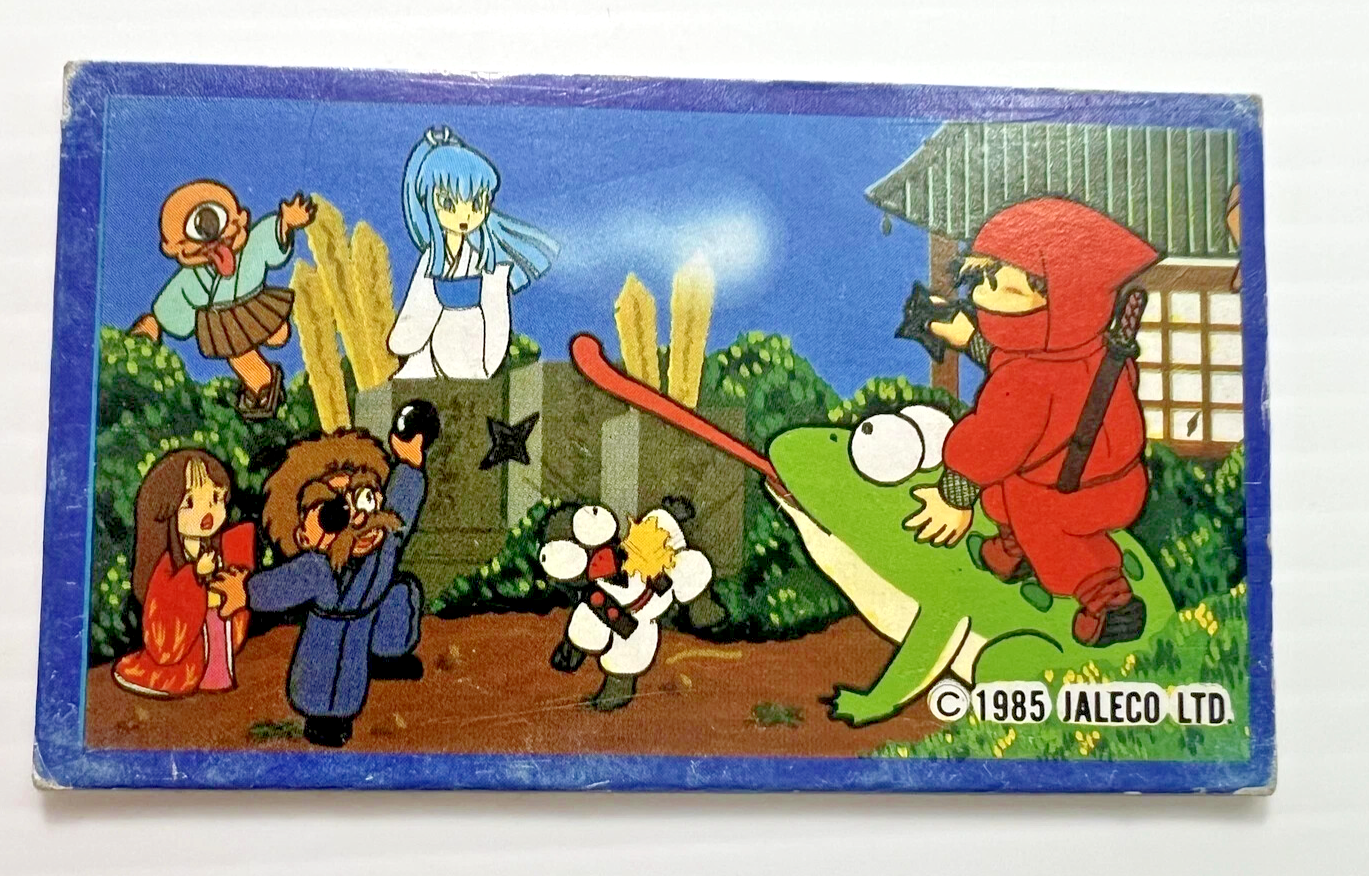
In 1985, two things arrived in Japanese candy shops at almost exactly the same moment: the Famicom version of Ninja Jajamaru-kun, and a matching wave of character menko cards. This card is one of them. Printed on thick rectangular cardboard with a full-color illustration and a blue border, it carries the official copyright “© 1985 JALECO LTD.” — placing its manufacture in the same year the game launched on Nintendo’s home console and became a hit.
Menko is a traditional Japanese game with roots in the Edo period. Players slap cards onto the ground to flip their opponent’s; the earliest versions were clay or lead, but by the postwar decades, thick cardboard had taken over. Through the 1950s to mid-1980s, character menko illustrated with anime, manga, and game characters became fixtures of dagashiya — the small neighborhood candy-and-toy shops that were a central institution of Japanese childhood. Unlike shokugan (cards or figures packed inside candy) or gashapon (capsule vending toys), menko were sold on their own and doubled as actual game pieces.
The Franchise, the Cast, and What the Card Shows
Ninja Jajamaru-kun was developed by JALECO (originally Nihon Leisure Co., Ltd.), a Japanese game company founded in 1974. The original arcade version appeared in 1984; the Famicom port launched in July 1985 and sold widely, earning it a place alongside Nintendo’s own early titles as one of the defining side-scrollers of the console’s first years. JALECO’s other games of the era included City Connection and Exerion, but Jajamaru-kun was their most prominent early hit.
The card’s illustration gathers the main cast. Jajamaru-kun — the red-clad young ninja protagonist — appears alongside Gamataro, the frog he rides through the game, and Princess Sakura, the white-robed heroine he sets out to rescue. Several other characters also appear: figures associated with a Daruma, a Kappa (the amphibious creature of Japanese folklore), and characters listed as Rokkaku and Yuki. A caveat here: these secondary figures may come from the game’s enemy roster, or from manga and anime adaptations of the series — their exact origins aren’t fully documented. A background of traditional Japanese architecture completes the frame and anchors the game’s folk-fantasy world.
A Japan-Only Game and the Culture That Surrounded It
Ninja Jajamaru-kun never received an official NES release outside Japan. For Western players, it has remained a Japan-only corner of the early Famicom library — known to retro game researchers but absent from the mainstream history most Western players inherited. Licensed merchandise from its peak year offers a direct point of contact with that gap.
Paper menko were made to be played with and frequently discarded. Forty years of handling are visible in the corner wear and light creasing this card shows — physical evidence of having circulated through actual hands in 1985. For collectors drawn to Famicom-era material culture, a licensed menko card represents that moment when a popular video game crossed into the everyday physical world of Japanese children.

Shipped from Japan, tested where noted in the listing
$8.15
Ships worldwide from Japan • Full photos and details on the listing