Touch Menko Card — Tatsuya Uesugi and Minami Asakura

The Series and the Creator
Touch is a manga by Mitsuru Adachi, serialized in Shogakukan’s Weekly Shonen Sunday from 1981 to 1986 across 26 volumes. It won the Shogakukan Manga Award in the boys’ category in 1982. A TV anime adaptation produced by Group TAC ran on Fuji TV from April 1985 to March 1987 — 101 episodes — with three theatrical films released in consecutive years from 1985 to 1987, a breadth of media coverage that was notable even among boys’ manga titles of the period.
The story centers on twins Tatsuya and Kazuya Uesugi, their childhood friend Minami Asakura, and the baseball club at the fictional Meisei High School. Adachi uses sport as the frame around something quieter: grief, growth, and the slow emergence of feelings between people who have known each other since childhood. His particular combination of athletic story and understated romance was widely influential on later manga, and the series has been broadcast internationally in markets including France, Italy, Spain, Taiwan, and South Korea.
What Menko Are and Why They Lasted
Menko are a Japanese game card format with roots in the Edo period, originally made from clay or lead and later standardized as printed cardboard. The game involves slapping your card down hard enough to flip your opponent’s card flat — whoever flips a card wins it. Through the 1960s, 1970s, and 1980s, menko were sold at dagashiya, the small neighborhood shops that were a fixture of everyday childhood in Japan, for just a few yen apiece.
Anime characters joined baseball players and wrestlers as common menko subjects during the Showa era, and the mid-1980s TV anime boom produced a large volume of tie-in cards. This card was most likely manufactured during Touch’s broadcast window of 1985 to 1987, in keeping with the standard practice of producing licensed merchandise concurrent with an airing series. By the 1990s, the format had been largely displaced by Carddass and trading cards, which offered collectibility by design. Menko production wound down, and cards that survived from the 1980s — alongside tie-ins for Dragon Ball, Kinnikuman, and their contemporaries — did so by chance rather than intention.
The Characters and the Card’s Design
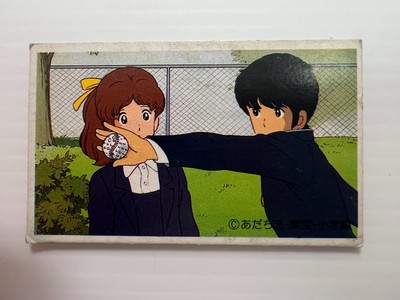
This card carries a copyright line reading © Mitsuru Adachi / Shogakukan, confirming official licensing. The figures depicted closely resemble Tatsuya Uesugi — the protagonist and pitcher who, after his twin brother’s death, gradually grows into the person his brother believed he could be — and Minami Asakura, the childhood friend and baseball club manager who became one of the best-known heroines in 1980s boys’ manga. The design shows Minami holding a baseball against a background of chain fencing and grass, placing all three of the story’s central elements together in a single image: sport, setting, and character.
The manufacturer’s name is not legible on the card. Several companies produced anime menko during this period, but which one is responsible for this particular card cannot be confirmed from the card itself.

Found in Japan, packed by hand, sent worldwide
$7.86
Worldwide delivery from Japan • See the listing for condition and size