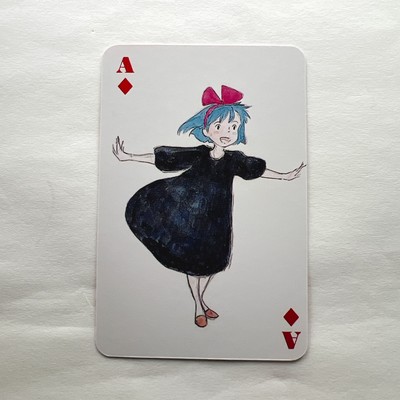
Kiki's Delivery Service Animage Playing Card, Ace of Diamonds (1989)

A Studio Ghibli Landmark and Its 1989 Moment
Kiki’s Delivery Service arrived in Japanese theaters on July 29, 1989, directed by Miyazaki Hayao and produced by Studio Ghibli. The story follows Kiki, a thirteen-year-old witch embarking on the traditional year of independence, striking out alone to an unfamiliar coastal city and supporting herself by running a broomstick delivery service. Based on Kadono Eiko’s 1985 novel, the film became the top-grossing domestic release in Japan that year and has since remained one of the most widely recognized titles in the Ghibli catalog. It has been distributed internationally, including in North America through Walt Disney Pictures.
The production involved three core parties: Studio Ghibli, Fuji Television, and Tokuma Shoten — the publishing house that co-financed the film and also publishes Animage magazine. That institutional overlap between publisher, magazine, and film studio is precisely what makes Animage-branded merchandise from this period a direct artifact of the Ghibli ecosystem as it existed in 1989.
Anime Magazines and the Playing Card Format
Animage was founded in 1978 and became one of the most influential magazines covering Japanese animation. Its relationship with Miyazaki Hayao ran deep from early on — the magazine serialized his manga Nausicaa of the Valley of the Wind before any film adaptation existed. When Kiki’s Delivery Service was released, an Animage tie-in was a natural extension of those long-standing ties.
Playing card sets were one of the most established formats for anime merchandise in 1980s and early 1990s Japan. A standard fifty-two-card deck gave publishers room to spread illustrations across characters and scenes, functioning almost as a visual companion to the film in pocket form. These goods reached fans through various channels: as magazine supplements, reader prize campaigns, mail-order offers in back issues, and sales at anime events. Whether this particular set was bundled with a magazine issue or sold separately is not definitively documented, but its connection to Animage is stated in the item itself.
Merchandise from this era also carries a distinctive look. The illustration style — watercolor washes, colored-pencil linework, a hand-drawn quality throughout — is a clear visual marker of the period and stands apart from the cleaner, digitally produced artwork of later decades.
Kiki’s Blue Hair and What It Tells Us
On screen, Kiki is defined by three consistent visual elements: black hair, a red ribbon, and a plain black dress. On this card, she is posed with her arms spread wide in an open, joyful gesture — the pose is immediately in character — but her hair is rendered in blue.
The reason for the discrepancy isn’t documented. Several explanations are plausible: a limitation or inconsistency in the color separation and printing processes of the era; an illustrator interpreting the design with some degree of creative latitude; or artwork drawn from early promotional materials that predated the film’s finalized color decisions. None of these can be confirmed. What is clear is that the blue hair is a consistent and visible feature of this card, one that sets it apart from merchandise aligned with the film’s standard palette. For anyone tracing the visual history of licensed Ghibli goods from the original release period, that kind of detail — even without a clean explanation behind it — is part of the record.


Shipped directly from Japan by a small shop
$8.82
Ships worldwide from Japan • Full photos and details on the listing