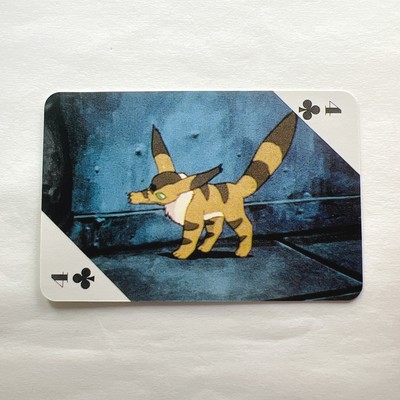
A 1984 Animage Playing Card Featuring Teto from Nausicaa of the Valley of the Wind

The Fox-Squirrel on the Four of Clubs
This is the four of clubs from what appears to be an Animage-branded character playing card deck, produced in 1984 to coincide with the theatrical release of Nausicaa of the Valley of the Wind. The character printed at the center is Teto, the fictional fox-squirrel who accompanies Nausicaa throughout the story. The layout follows standard playing card conventions: suit symbol and numeral in each corner, character illustration in the middle.
Teto appears early in the film in a scene that says a great deal about who Nausicaa is. He bites her finger on first contact — a defensive reflex — and she holds steady without flinching. From that point on, he rides her shoulder, a small and steady presence woven into almost every scene. His design is distinctive: tawny body, brown stripes, oversized pointed ears, bright green eyes, white chest. Miyazaki created him as an entirely original species — the fox-squirrel — native to the imagined ecology of the film’s far-future world. He appears in both the manga and the film, and for many viewers he has become one of the most recognizable visual elements of the whole property, standing alongside Nausicaa herself as a symbol of the film’s themes of gentleness and coexistence with nature.
Nausicaa Before Studio Ghibli
The film opened in Japan on March 11, 1984. Hayao Miyazaki wrote and directed it, adapting the manga he had been serializing in Animage magazine since February 1982. Production was handled by Topcraft, with Toei as the distributor. Studio Ghibli did not yet exist — it was established in 1985 — and Nausicaa is broadly understood as the creative and commercial foundation that led directly to its formation. It was Miyazaki’s first feature-length commercial directorial work, and its position in Japanese animation history rests on those terms alone.
Outside Japan, the film’s theatrical history began with a heavily edited US version in 1985. Official Animage merchandise from the original Japanese release — including goods like this card — was never distributed through Western retail channels, which is part of why these items remain unfamiliar to many international fans despite the franchise’s enduring reputation.
Animage Cards and the 1980s Anime Boom
Animage is the anime specialty magazine published by Tokuma Shoten since 1978 — the same publication that serialized the Nausicaa manga and the brand under which associated merchandise was produced. Playing cards were a standard format for anime character goods in this period. A 54-card deck could showcase an entire cast, with each suit and number assigned a different character or scene image. This card would have been one tile in that larger visual set.
Because decks were functional objects as well as collectible ones, surviving examples in good condition are not uniformly common. This listing is for a single card rather than a complete deck, which means it was separated from the set at some point. That changes how different collectors might approach it: someone building a complete run and someone drawn specifically to Teto’s image will have different relationships to the same piece.
Shipped directly from Japan by a small shop
$8.82
Ships worldwide from Japan • Full photos and details on the listing