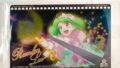
Nausicaä of the Valley of the Wind Playing Card, Hearts Q (Animage, 1984)

A Playing Card Format with Deep Anime Roots
This is a single playing card — the Queen of Hearts — from a character playing card set produced in Japan in 1984 and branded by Animage, the monthly anime magazine published by Tokuma Shoten. Character playing cards were one of the defining merchandise formats of the early Japanese anime boom: they circulated through toy and stationery shops, appeared at events, and were occasionally bundled as magazine supplements. A full set would have included 52 cards plus a joker. Whether this particular set reached its audience through retail, as a promotional item, or by another route is not documented. The card follows the standard Japanese specification with rounded corners, and its face depicts a large gray-blue aircraft in flight against an open sky — most likely one of the heavy transport vessels operated by the Tolmekian military, though a precise identification is not certain.
Nausicaä, Animage, and the Road to Studio Ghibli
Nausicaä of the Valley of the Wind began as a manga by Hayao Miyazaki, serialized in Animage starting in February 1982. The theatrical anime adaptation followed on March 11, 1984, produced by Top Craft. Studio Ghibli was not founded until 1985 — the year after this film’s release — which makes Nausicaä the direct predecessor to the studio and its subsequent work, from Laputa: Castle in the Sky to My Neighbor Totoro and beyond.
The Animage branding on this card is more than a publisher’s mark. The magazine serialized the original manga, and its editorial team was deeply involved in the film’s production: editor Toshio Suzuki participated as a producer on the project. That relationship places Animage merchandise in an unusually close position relative to the source material.
Internationally, the film had a complicated early life. In 1985, Warner Bros. released a heavily edited English dub in North America under the title Warriors of the Wind. A complete and faithful version did not reach English-speaking audiences until 2005, through Disney. The global fanbase that exists today largely came to the film through that later release.
Aircraft, Miyazaki, and the Appeal for Collectors
Aviation and flight run throughout Nausicaä — both as story elements and as a reflection of Miyazaki’s well-documented fascination with aircraft and flying machines. The film features several distinctive vessels: Nausicaä’s small personal glider the Mehve, fighters from the city of Pejite, and the large armored transports of the Tolmekian army. Mecha and aircraft design is a significant part of what makes the film distinctive, and merchandise depicting those machines draws interest beyond the core fanbase, including collectors focused on retro anime mechanical design.
For anyone drawn to pre-Ghibli anime history, this card sits at a specific and well-defined moment: produced in the year the film opened, under the brand of the magazine that helped bring it to screen. More than forty years on, complete sets from that period are naturally uncommon, and a single card offered individually can find a home in a display or collection as easily as in a full deck.


Comes straight from Japan — no middleman
$8.82
Ships internationally • More photos on the eBay listing