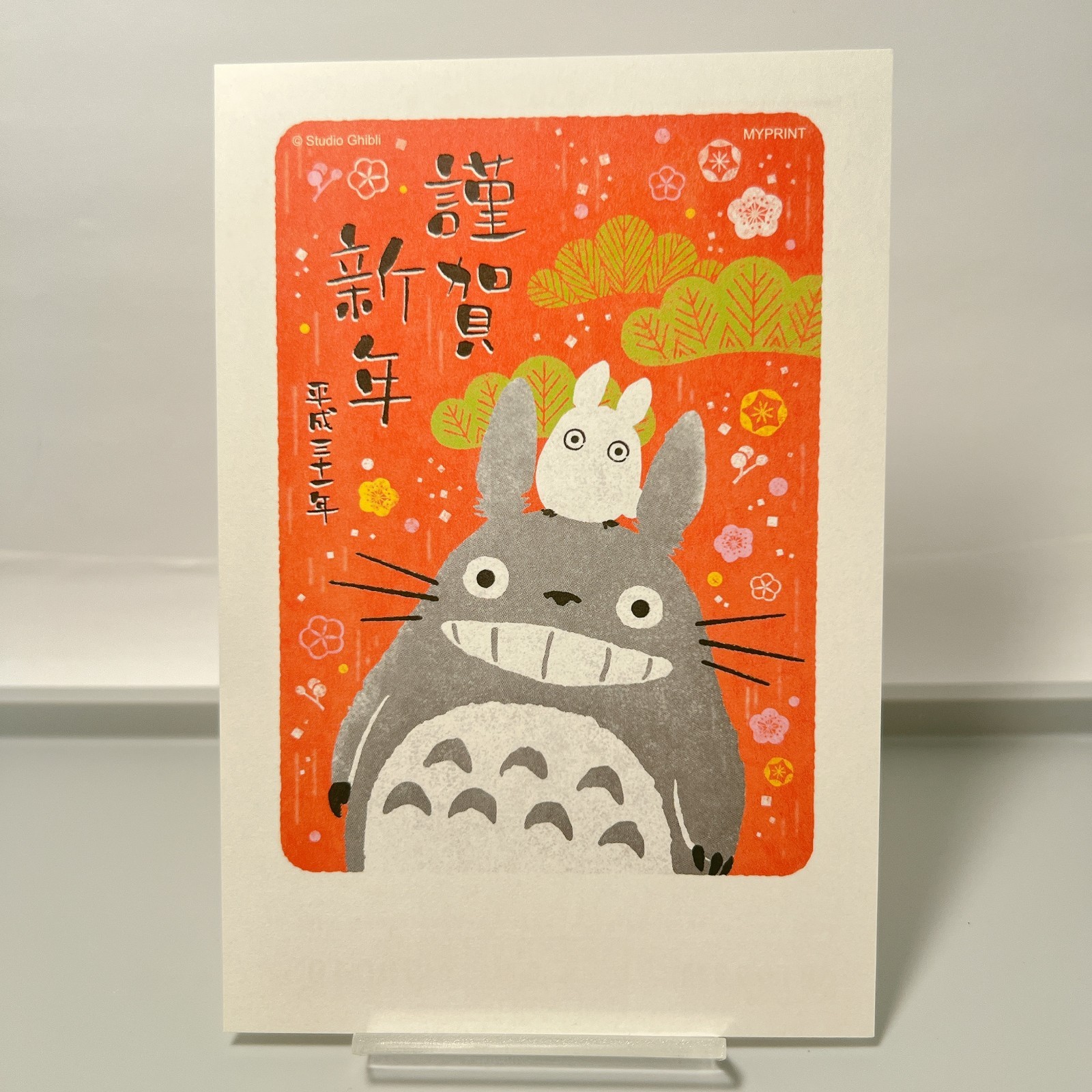
Studio Ghibli Totoro New Year Card, Heisei 31 (2019)

A Studio Ghibli Card Rooted in Japanese New Year Tradition
This is an officially licensed Studio Ghibli nengajo — a Japanese New Year greeting card — produced for the 2019 season. The front carries the formal brush-calligraphy greeting “kinga shinnen” (the Japanese equivalent of “Happy New Year”) alongside two immediately recognizable figures: the large gray Totoro and the small white Totoro perched above him. The background runs in warm red-orange, layered with traditional Japanese New Year plant motifs — pine, bamboo, plum, nandina, and camellia — giving the design a distinctly festive seasonal character rooted in Japanese visual tradition.
The card is marked with both “© Studio Ghibli” and the name “MYPRINT,” the card’s printer. One notable feature is the surface itself: the listing describes it as felt wool, and a textured quality is visible in the card. Whether the material involves actual applied felt or a felt-effect printing and embossing process is something that cannot be confirmed from imagery alone — but either way, the finish clearly sets this piece apart from standard flat-printed stationery.
Totoro: From Forest Spirit to Studio Ghibli’s Defining Character
My Neighbor Totoro was released in 1988, directed by Hayao Miyazaki and produced by Studio Ghibli. It premiered as a double bill alongside Grave of the Fireflies and has since become one of the most celebrated animated films in the world. The story follows two sisters, Satsuki and Mei, who discover a series of gentle forest spirits in the countryside around their new home. The largest and most memorable is the creature the children name Totoro — a gray, round-bellied being with enormous ears who lives in an ancient camphor tree.
Totoro occupies a unique position within Ghibli’s catalogue: the studio chose him as the centerpiece of its own logo, placing his silhouette on every production it releases. He is, in that sense, less a character from a single film and more the emblem of the studio itself. International audiences know him through GKIDS, which distributes the film in North America, and through Netflix, which has made the entire Ghibli catalogue available across many regions. The card’s composition — large Totoro with small Totoro seated above him — echoes an arrangement used repeatedly in official merchandise, one of the franchise’s most familiar visual shorthands.
The Last New Year Card of Japan’s Heisei Era
The card is dated “Heisei 31” in the traditional Japanese imperial calendar format — a designation that carries more weight than it might initially appear. Heisei 31 corresponds to 2019, and it turned out to be the final year of that era. Emperor Akihito abdicated on April 30, 2019, and the Reiwa era began the following day. Any item dated “Heisei” from that year is, in retrospect, a product of the era’s final months.
Japanese New Year cards are designed for a single season; each year’s designs are retired and replaced. This 2019 Totoro nengajo was not reprinted for the following year, as that would have been a Reiwa-era card requiring a new date and, typically, a new design. The card represents one moment in the long tradition of the nengajo — a custom with no real equivalent outside Japan, where exchanging printed New Year greetings by post has been a widely practiced seasonal ritual for generations. The combination of a globally recognized character, a craft tied to Japanese New Year culture, and the historical timestamp of Heisei’s final year gives this particular card a context that goes well beyond a standard piece of licensed stationery.


Shipped directly from Japan by a small shop
$9.65
Ships worldwide from Japan • Full photos and details on the listing