A Vintage Round Menko Card from Showa-Era Japan

The Game Behind the Card
Menko are thick cardboard game cards that defined children’s street play in Japan for much of the 20th century. The game is simple: stack cards face-up on the ground, then take turns slamming your own card down hard enough to flip an opponent’s over — by direct hit or the burst of air pressure from the impact. Whoever flips the card keeps it. The format goes by regional nicknames like “bettan” or “pachin” across different parts of Japan, but the object everywhere was the same.
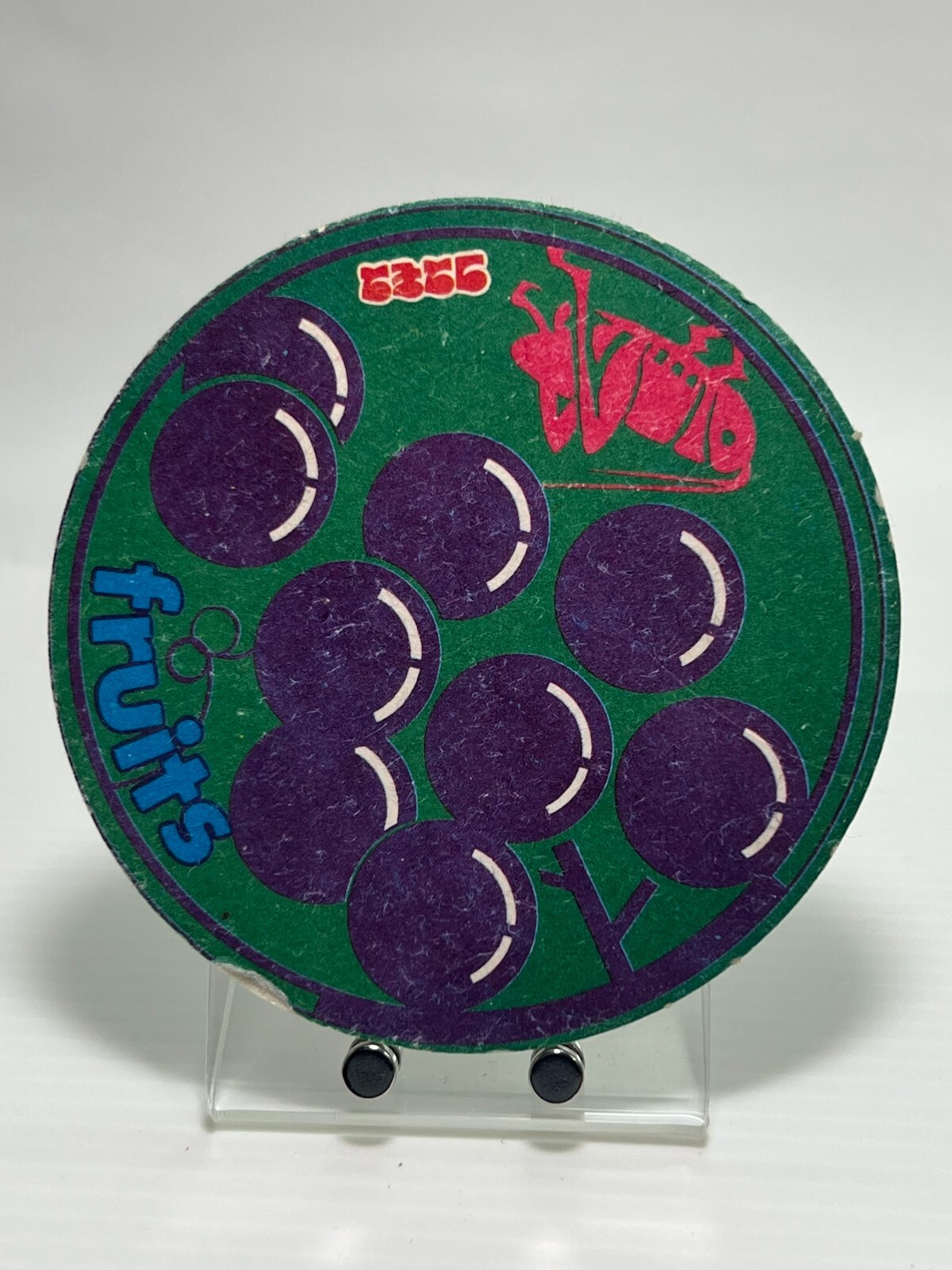
This particular card is a circular menko decorated with a grape motif — the round format was one of several standard shapes during the Showa period, alongside rectangles and hexagons. The design prints the English word “fruits” in vertical lettering on the left side, the Japanese hiragana for grapes in red in the upper right, and the number 5355 in the upper left, likely a production lot or series identification number. No licensed character, manga series, or anime franchise is connected to this card; it belongs to the broad category of general-purpose menko printed with everyday subjects — fruit, animals, vehicles — that circulated alongside the more widely recognized character versions.
The Dagashi-Ya Era and How These Cards Were Sold
Paper menko peaked commercially during the 1950s and 1960s, sold cheaply through dagashi-ya — the small neighborhood penny candy and toy shops that were central to postwar Japanese childhood. A ten-card pack or a loose handful from the shop’s bin cost almost nothing, which was the point: menko were consumables meant to be played with, won, lost, and replaced.
Fruit and nature themes like this grape design came from publishers and toy wholesalers who packaged generic content for mass distribution without the licensing costs that character menko required. Who made this specific card is not confirmed — many Showa menko of this type were unbranded products from regional printers and distributors. The round format, thick pasteboard stock, and bold lettering are consistent with mid-Showa production, though an exact date cannot be confirmed. When home video games spread through Japan from the late 1970s onward, street games like menko declined rapidly, production volumes fell, and the earlier cards gradually shifted from childhood toys into objects of nostalgic interest.
Showa Graphic Art and the Appeal for International Collectors
Two features of this card stand out for an international audience. The first is the bilingual text: “fruits” in Roman letters alongside the Japanese hiragana for grapes reflects the Showa-era taste for pairing Western-modern styling with Japanese consumer goods — a visual approach found across toys, packaging, and printed materials of the period, and one that reads today as a marker of the era’s particular cultural mood.
The second is the graphic style itself. The grape illustration is boldly stylized: dense purple clusters against a green background, with the hiragana lettering drawn in a near-abstract decorative script where visual impact takes priority over legibility. That quality — immediate, high-contrast, unconcerned with realism — is characteristic of mid-century Japanese commercial printing and gives generic menko like this one a distinct graphic identity well beyond their original function as game pieces. For collectors focused on Showa design rather than specific franchises or characters, that identity is precisely the point.


Comes straight from Japan — no middleman
$8.15
Ships internationally • More photos on the eBay listing