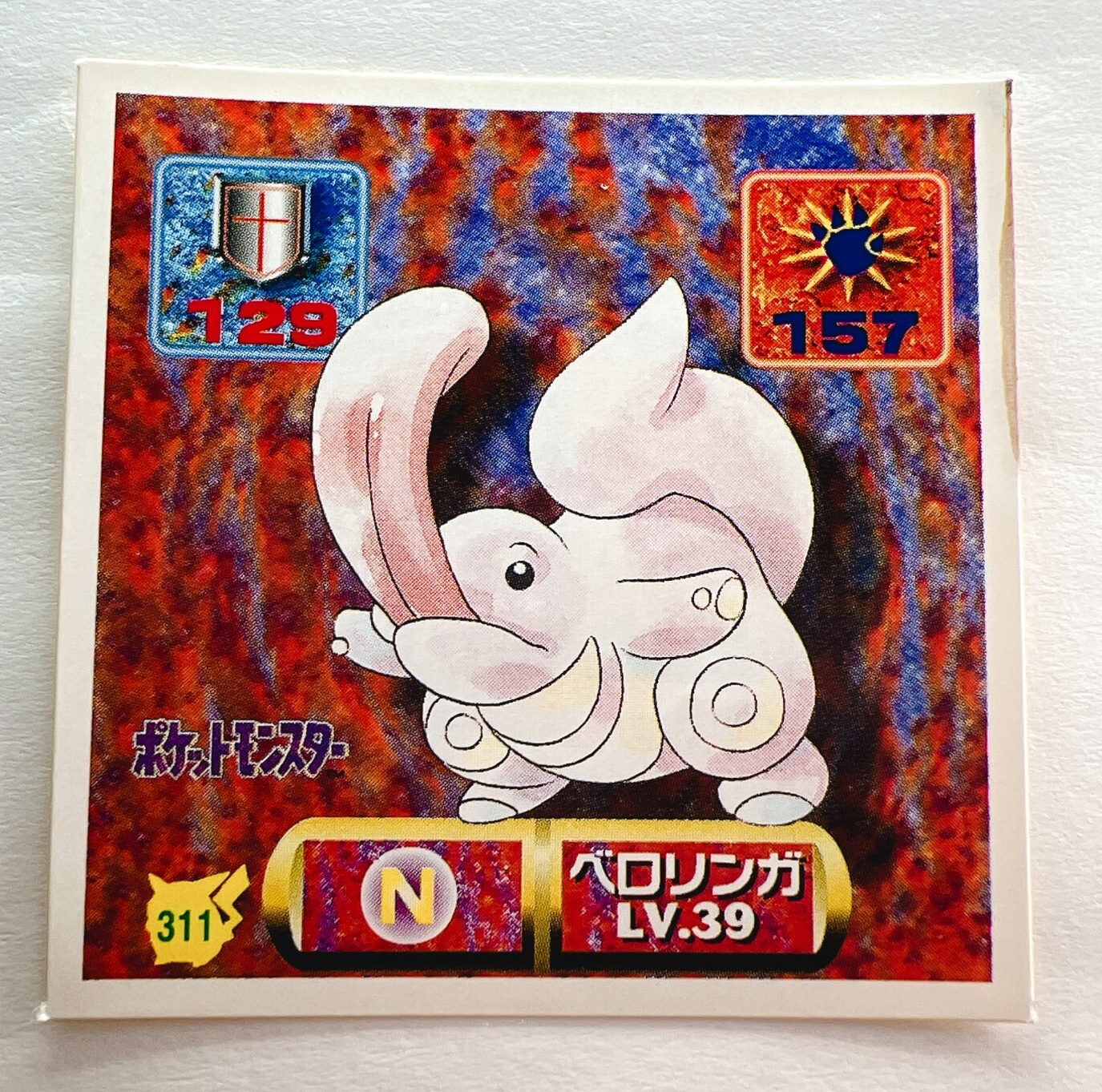
Lickitung No.311 Amada Pokemon Sticker (1997): A First-Generation Japanese Collectible

What You’re Looking At
This is a single sticker card from Amada’s official Pokemon sticker series, produced in Japan in 1997. Within the Amada lineup, it carries the series number No.311 — a sequential collector’s number internal to the Amada set, not Lickitung’s National Pokedex number (which is 108). The sticker features Lickitung rendered in a game-card style design, complete with printed stat-like figures: a shield-icon value of 129, a starburst-icon value of 157, and a level indicator of LV.39. These aren’t playable game stats — they’re decorative design elements that mimic the look of a game screen, a presentation style popular with Japanese sticker cards of the era. A circular “N” badge also appears on the card; this is generally understood to indicate a series or version classification within Amada’s product range, though its precise meaning is not definitively documented.
The Franchise and the Character Behind the Sticker
Pokemon launched in Japan in February 1996 as a Game Boy RPG developed by Game Freak and published by Nintendo. The anime adaptation began airing on TV Tokyo on April 1, 1997 — the same year this sticker was produced — placing this item squarely in the height of Japan’s first Pokemon boom. At the time, the franchise consisted of the original 151 Pokemon, all belonging to what collectors now call the First Generation.
Lickitung is National Pokedex No.108, a Normal-type Pokemon roughly 1.2 meters tall and known above all else for its extraordinarily long tongue — a defining visual trait that makes it immediately recognizable. In the original Red and Green games, Lickitung was not available through standard wild encounters; it could only be obtained through a specific in-game trade at the Safari Zone, making it one of the more memorable Pokemon for players who went looking for a complete Pokedex. It also appeared in the anime’s first season, most famously in an episode where Jessie of Team Rocket captures one — an episode that gave the character lasting recognition beyond its game role.
Amada Stickers and Japan’s 1990s Collector Culture
Amada (now Amada Printing) was a Japanese sticker card manufacturer that held official licenses for many of the defining anime and game franchises of the 1980s and 90s, including Dragon Ball, Sailor Moon, and Yu-Gi-Oh. Their Pokemon stickers were produced in multiple formats — standard, holographic, and prism finishes among them — though determining exactly which version a specific card belongs to from images alone isn’t always straightforward.
Amada’s stickers occupied a distinct space in the Japanese collectibles market: sold individually at convenience stores, candy shops, and stationery stores at prices accessible to children’s pocket money, they functioned as a pure collection medium rather than a food toy premium. The numbered series format — with No.311 suggesting a very large set — was a deliberate design choice to encourage completionist collecting, a standard feature of Japanese sticker culture that traces its roots back to the Bikkuriman chocolate wafer stickers of the 1980s.
For international collectors, items like this carry particular significance as primary-source artifacts from the period before Pokemon expanded outside Japan. The product carries Japanese-language “Pocket Monsters” branding rather than the internationally standardized “Pokemon” mark, reflecting its origin in the franchise’s earliest domestic phase. Amada products were distributed almost entirely within Japan, so their presence outside the country remains limited relative to the original production run — and nearly 28 years of time have added to the natural variation in how individual pieces have survived.


Price: $7.67 | View on eBay