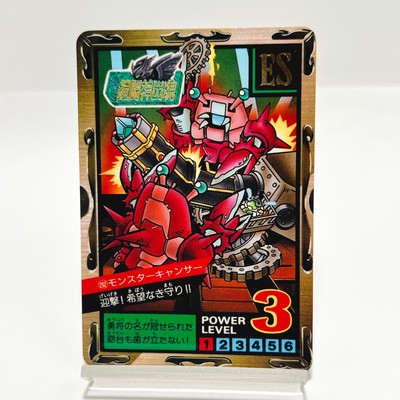
Monster Cancer No.262 — SD Gundam Kikoujin Densetsu Carddas Card (Bandai, 1996)

SD Gundam’s Medieval Fantasy Universe
In 1979, Mobile Suit Gundam introduced the world to Yoshiyuki Tomino’s vision of giant mecha warfare, produced by Sunrise. Roughly a decade later, Bandai took those same iconic machines and placed them inside a completely different world. The SD — Super Deformed — format reimagined Gundam’s robots with exaggerated, cartoonish proportions, and its most celebrated spin-off recast them as knights, wizards, and monsters in a medieval fantasy setting. That series, SD Gundam Gaiden: Knight Gundam Monogatari, debuted in Comic Bom Bom magazine in 1988 and became enormously popular with its young readership.
This card belongs to the Kikoujin Densetsu — Armored God Legend — branch of that universe, which placed colossal divine-mechanical beings called Kikoujin at the centre of its mythology. The phrase printed on the card, referencing a Kikoujin’s appearance, positions Monster Cancer directly within that storyline and its particular scale of conflict.
A Crab Monster With a Zodiac Name
Monster Cancer draws its name from the Cancer constellation — the crab of the zodiac — and the card’s artwork makes that reference unmistakable: a large, red, crab-shaped mechanical creature equipped with oversized weaponry, gears, and smaller insectoid forms clustered around it. Assigning astronomical and mythological names to enemy characters and creatures was a recurring device in the SD Gundam Gaiden world, where the forces of darkness borrowed from the heavens for their imagery. The design blends organic and mechanical elements in a way characteristic of the series’ “demonic beast” faction.
The card records a Power Level of 3 and an “ES” classification, indicating that it was part of a gameplay system rather than a purely decorative collectible — players could use these stats in structured matches. What “ES” specifically denotes, whether a rarity tier, a card sub-type, or another category, is not definitively established in available records. The card’s gold decorative border and gear-motif corner design are consistent with the visual language of Bandai’s Carddas series from this period.
Carddas and the Vending Machine Era
Bandai launched the Carddas system in 1988, distributing individual cards through dedicated vending machines installed in convenience stores and toy shops across Japan. At roughly 20 to 30 yen per card, the format was accessible to primary school students, but building a complete set demanded persistence and a considerable number of visits to the machine. Dragon Ball and SD Gundam were among the system’s earliest and most popular titles, and both helped define what the format could be.
By 1996, Carddas had been running for nearly a decade and the SD Gundam Knight universe had grown into a layered, multi-branch mythology. Card number 262 points to a series of significant size — whether the count reflects a single large release or a numbered run spanning multiple sets is difficult to determine from the card alone, but it suggests the breadth of the world Bandai had built around this franchise by that point.
For collectors outside Japan, cards from this era represent a format that was essentially domestic: individual vending machine pulls, entirely in Japanese, from a franchise with only limited official presence abroad at the time. The monster and villain cards from these sets tend to attract particular interest from fans of the fantasy RPG aesthetic that the Knight Gundam series embodied — an unusual corner of the Gundam universe that never made it overseas in its original form.


Found in Japan, packed by hand, sent worldwide
$8.82
Worldwide delivery from Japan • See the listing for condition and size