1980s Saint Seiya Andromeda Shun Menko Card, Sega License

What a Menko Card Is — and Why Sega Made One
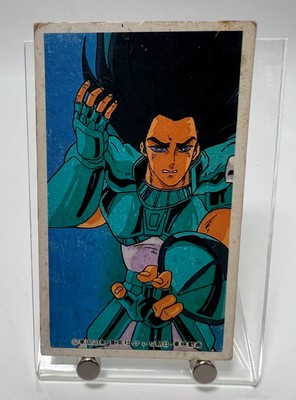
Menko are thick paper cards used in a traditional Japanese children’s game with roots in the Edo period. The basic mechanic involves slamming your card against the ground next to an opponent’s; the air pressure or impact flips the target, and whoever flips the other’s card keeps it. By the mid-twentieth century, menko had absorbed popular culture wholesale — baseball players, kaiju, and anime heroes all ended up on them. This card carries copyright notices for Sega alongside those of Masami Kurumada, Shueisha, and Toei Animation, confirming that Sega held an official license for Saint Seiya merchandise during the anime’s broadcast run. The white-bordered, matte-finish, full-color card is consistent with how domestic Japanese menko were produced in the 1980s; age-related discoloration at the edges and a small chip at the upper-left corner indicate it is an original piece from that era, not a later reproduction.
The World of Saint Seiya and the Bronze Saint on This Card
Saint Seiya began as a manga by Masami Kurumada, running in Weekly Shonen Jump from 1985 to 1990. Toei Animation brought it to television from October 1986 to April 1989 — 114 episodes in which young warriors called Saints, armored in constellation-themed suits called Cloths, fight to protect the goddess Athena. It was among the biggest titles in Shonen Jump’s late-1980s lineup, airing during the same years as Dragon Ball.
The character on this card is Andromeda Shun, one of the five central Bronze Saints. He wears the Andromeda Cloth — recognizable by its teal and turquoise tones — and wields the Nebula Chain. Shun’s long dark hair, blue eyes, and androgynous appearance set him apart from the other leads, and he drew a particularly devoted fanbase, especially among female viewers. Within the group he functions as a steadying presence, written as intensely loyal to his companions.
An Anime That Crossed Oceans, on a Format That Rarely Did
Saint Seiya’s international footprint is larger than most anime of its generation. The series aired in France as Les Chevaliers du Zodiaque and reached audiences in Brazil, Spain, and Italy through the 1990s, building a fanbase across Europe and Latin America that has remained active for decades. Andromeda Shun is one of the more recognizable characters within those fan communities.
Menko, by contrast, never traveled. The format stayed almost entirely within Japan and faded from mainstream use in the 1990s as trading card games took over. What replaced menko’s market position was the TCG; what remained of menko entered the collector space as documents of Showa-era childhood — produced in a window when offset printing, flat paper cards, and licensed anime characters intersected with a generation of Japanese children’s daily play. Sega’s role as licensee adds a further thread: the company was simultaneously building its identity as a console hardware maker with the Master System and Mega Drive, while also attaching its name to character goods like this one.

Found in Japan, packed by hand, sent worldwide
$7.86
Worldwide delivery from Japan • See the listing for condition and size