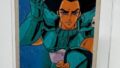
Nise Gundam Playing Card from Comic BomBom, February 1990

A Parody Character at the Peak of SD Gundam
This card — the 8 of Spades — came packaged as a free bonus insert (furoku) with the February 1990 issue of Comic BomBom, Kodansha’s manga magazine for younger readers. The subject is Nise Gundam, a parody character from the SD Gundam universe whose name translates as “fake Gundam.” The card’s artwork earns that name: the design borrows the RX-78-2’s yellow V-fin antenna, blue beam rifle, and red-and-white shield, but adds a large pink single eye and yellow star markings that mark it unmistakably as the impostor version.
SD Gundam — standing for Super Deformed — reimagines the mecha of the Mobile Suit Gundam franchise in an exaggerated chibi style with oversized heads and squat proportions. Mobile Suit Gundam itself launched as a Sunrise TV anime in 1979 and became one of Japan’s defining robot anime properties. The SD spin-off caught on via Bandai’s BB Senshi plastic model kits from the mid-1980s onward and by 1989–1990 had expanded into anime OVAs, manga, card sets, and merchandise across virtually every category. Comic BomBom was one of the main venues for SD Gundam manga during those peak years, making it a natural home for Gundam-themed bonus inserts. Nise Gundam — a deliberate counterfeit built to resemble the series’ hero mech while being distinctly not the real thing — suited the comedic, self-aware spirit the franchise embraced throughout this era.
The Furoku Tradition in Japanese Manga Publishing
Furoku were never sold separately. Japanese children’s manga publishers competed on the quality of their bonus inserts as fiercely as on their story content, and Comic BomBom delivered stickers, mini card games, and novelty sets like this playing card deck as standard reader rewards. The key constraint is that furoku were tied to a single issue: distributed only through bookstores and convenience stores during that month’s publishing window, produced in quantities matching the magazine’s print run, and never reissued as standalone merchandise. Once an issue left shelves, the only route to one was through second-hand channels.
Why This Corner of the Gundam Universe Attracts Collectors
Mobile Suit Gundam has maintained a serious international following since the original series, and SD Gundam carries its own distinct appeal among collectors drawn to the chibi aesthetic. Nise Gundam adds a second layer: the “fake Gundam” premise functions as genuine meta-humor for anyone who knows the RX-78-2, turning the character into something that rewards franchise familiarity rather than merely illustrating it.
The February 1990 date anchors this card at a specific cultural moment — Japan at the height of the SD Gundam boom, produced by one of the franchise’s central manga publishing partners and issued just ahead of the 1991 theatrical release of Mobile Suit Gundam F91, when the broader Gundam IP was gaining fresh mainstream attention. As a non-commercial supplement that was essentially unavailable through international retail at the time of release, it belongs to a category of Japanese pop-culture material that existed entirely within the magazine-buying ecosystem of the era.


Shipped directly from Japan by a small shop
$8.82
Ships worldwide from Japan • Full photos and details on the listing