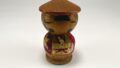
Dorami Capchara Gashapon Figure by Bandai

Doraemon’s Yellow Sister, Captured in a Capsule
Dorami — known affectionately as Dorami-chan — is one of the most distinctive supporting characters in the Doraemon universe. She is Doraemon’s sister robot, a relationship the original manga establishes through a shared origin: both robots were produced from the same can of oil. While Doraemon is the blue cat-bot familiar to generations of readers and viewers, Dorami stands apart at a glance — yellow body, white face, oversized red ribbon on her head, blue collar, and soft pink cheeks. Her personality offers its own contrast: she is described in the story as more meticulous and capable than her brother, giving her a distinct identity rather than simply a reflection of the main character.
She first appeared in a 1973 manga work titled “Dorami-chan” and went on to become a recurring presence in the long-running TV anime. She has also appeared as the lead character in spinoff productions including “Dorami & Doraemon-zu,” which has deepened her following among fans who appreciate her beyond the main series.
How the Capchara Concept Works
This figure belongs to Bandai’s Capchara line — a portmanteau of “Capsule” and “Character” that describes exactly what sets these pieces apart. The character’s head forms the upper half of the capsule (the removable cap), while the body occupies the lower half, so the figure and its casing are one integrated object. When taken from the vending machine, the silhouette is already complete — the capsule is not a wrapper to discard, it is the figure itself, made from hard plastic throughout.
Capchara sits within Bandai’s broader gashapon operation, which the company has run in Japan since 1977. (Gashapon is Bandai’s registered trademark for its capsule-toy vending-machine products and the items sold through them.) Gashapon figure craftsmanship improved considerably through the 2000s, and lines built around a specific design concept — like Capchara’s capsule-integration approach — began attracting collectors alongside casual buyers. The Capchara line became active in earnest from the late 2010s, though the exact release year of this particular Dorami figure cannot be confirmed from available information alone.
Dorami Within a Global Franchise
The Doraemon franchise was created by Fujiko F. Fujio and first published in Shogakukan’s school magazines in 1969. The TV Asahi/Shin-Ei Animation series has run since 1979 and continues in production today; theatrical films have released annually since 1980. The IP carries strong recognition across East and Southeast Asia — in Chinese-speaking markets, Korea, and beyond — and is recognized as “Doraemon” in English-speaking countries as well.
Within that broad catalog, Dorami occupies a specific niche. Merchandise and figures tend to center on Doraemon himself, so products that feature Dorami as the primary subject are produced less frequently. Her yellow-and-red coloring and chibi proportions make her immediately recognizable in a display context, but releases built around her alone represent a narrower slice of the overall Doraemon gashapon catalog. Bandai gashapon are sold through vending machines in Japanese stores, game centers, train stations, and tourist spots, with no official international distribution channel. For collectors outside Japan, import through individual sellers is typically the only way to acquire them.


Boxed and cushioned for the trip from Japan
$15.63
Worldwide delivery from Japan • See the listing for condition and size