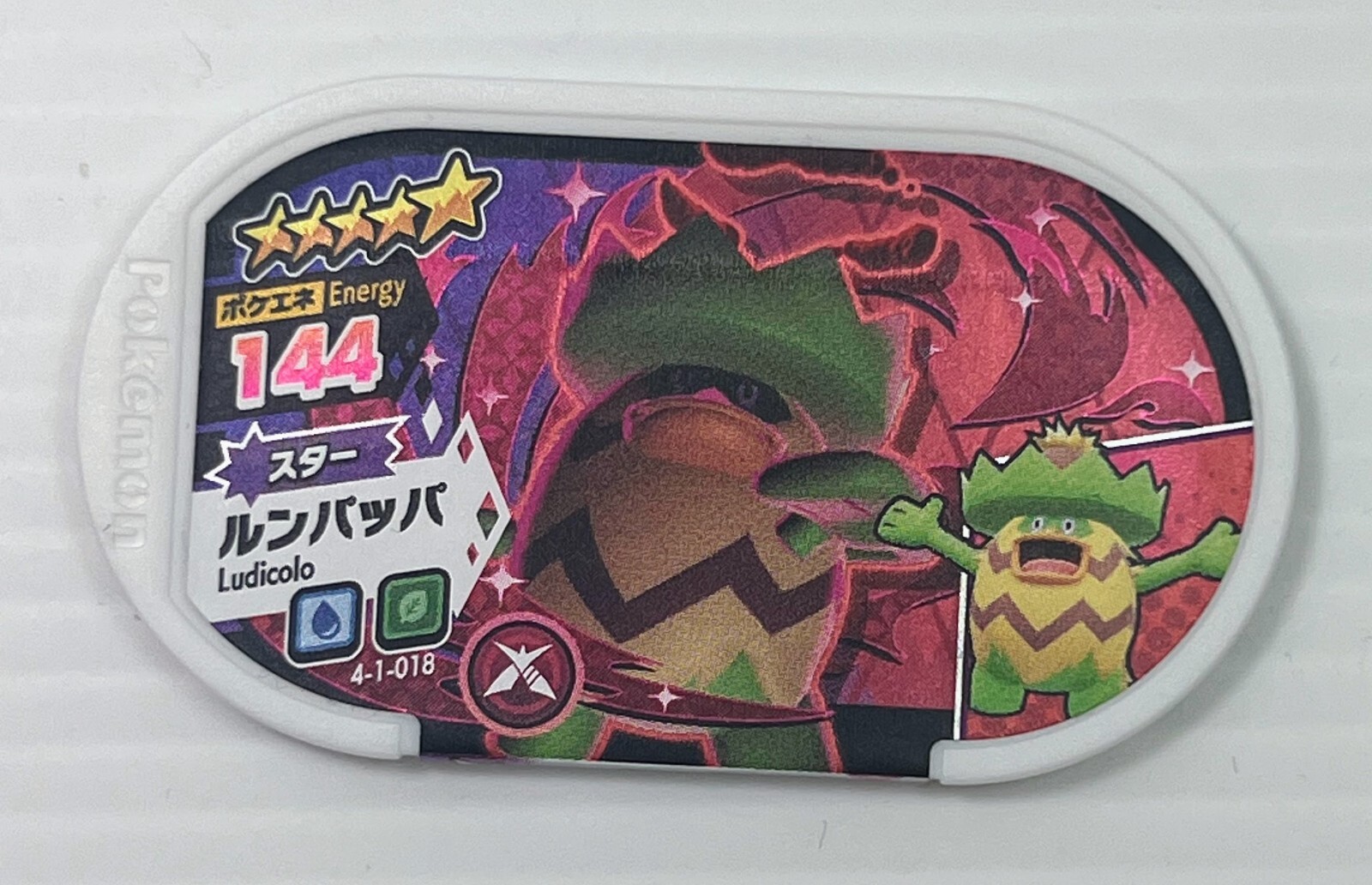
Ludicolo Pokemon Mezastar Arcade Tag (No. 4-1-018)

A Token That Lives Between the Arcade Machine and the Display Shelf
The item in this listing is a Mezastar tag — an oval, hard-plastic token produced for Pokémon Mezastar, a Pokémon-branded arcade game series developed and operated by Taito Corporation in Japan. Unlike a trading card, this tag is designed to slot directly into a dedicated arcade cabinet’s reader, where it feeds the game’s battle system with the Pokémon’s stats, type icons, and move attributes. Once a play session ends, the tag ejects into a tray and the player keeps it — which is how these pieces find their way into private collections.
The Mezastar series launched in Japanese arcades in September 2020 as the follow-up to Pokémon Ga-Olé (2016–2020), another Taito-produced Pokémon arcade series. Gameplay works by inserting coins, completing a battle sequence, and receiving a randomly dispensed tag. Each tag carries an item number — here, 4-1-018 — widely understood to indicate Series 4, Set 1, entry 018, placing the release at approximately 2022. Tags are graded by a star-based rarity system; this Ludicolo carries a five-star gold rating, which sits in the upper tier of the standard dispensing pool. Taito, best known internationally for Space Invaders and now operating as a Square Enix subsidiary, handles both the cabinet hardware and the rolling content updates that introduce each new series of tags.
Ludicolo: Hoenn’s Water-Grass Dancer
Ludicolo (National Pokédex #272) debuted in Pokémon Ruby and Sapphire for the Game Boy Advance in 2002 as the final stage of a three-step evolutionary line: Lotad evolves into Lombre, which then becomes Ludicolo via a Water Stone. Its dual Water/Grass typing matches the type icons printed on this tag.
The design draws heavily from Mexican and South American folk-music traditions — samba rhythms, mariachi imagery — giving Ludicolo a loose-limbed, festive silhouette: a broad lotus-leaf hat, a round patterned body, and cheerful polka-dot markings. Its official Pokédex classification is the “Carefree Pokémon,” and that personality carries through into the anime, where the character made a memorable impression during the Hoenn story arc. For players who grew up with the GBA era, Ludicolo is a recognizable face with a distinct visual identity that sets it apart from more conventional Pokémon designs.
Arcade-Only Items and Japan’s Random-Dispense Collecting Culture
Mezastar tags are produced exclusively for Japan’s arcade market — game centers, shopping-mall arcade corners, and similar venues. There is no official overseas retail channel. The only way to obtain one through primary distribution is to play the cabinet in person in Japan, so collectors outside the country rely entirely on secondary sources. This structure reflects a broader Japanese collecting tradition that sits alongside gashapon capsule toys and food-prize figures: all organized around randomized dispensing rather than straightforward retail purchase.
The physical format is itself a distinguishing feature for collectors more familiar with the Pokémon Trading Card Game. Both originate from the same franchise, but the object type, the acquisition method, and the tactile experience are entirely different — a sturdy, three-dimensional plastic token rather than a flat printed card. For fans building a broad Pokémon collection, a Mezastar tag occupies a category that exists only within Japan’s arcade ecosystem, and the item number provides the precise series-and-set coordinates that completionist collectors use to track their holdings.

Found in Japan, packed by hand, sent worldwide
$8.15
Worldwide delivery from Japan • See the listing for condition and size