Dragon Ball Wafer Sticker No.16 — Son Goku and Piccolo

A Paper Sticker with Premium Surface Treatment
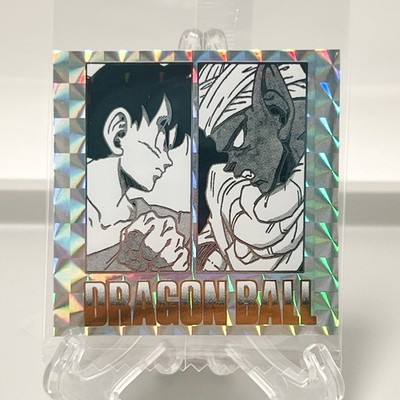
This item is a paper collector sticker packed inside a Japanese wafer biscuit — a thin, crisp candy sold in individual foil packets. One sticker comes sealed with each wafer, chosen at random from the full numbered series. No.16 depicts Son Goku and Piccolo in an apparent confrontation, rendered in monochrome manga-style linework. A holographic-check border frames the image and the series logo is printed in metallic ink — surface treatments that elevate the piece well beyond a standard paper sticker and into territory more familiar to trading-card collectors. Bandai, the leading Japanese producer of Dragon Ball food-toy lines, is the most likely manufacturer, though the specific series name and release year cannot be confirmed from the images alone.
Son Goku and Piccolo Within the Dragon Ball Story
Dragon Ball is the manga created by Akira Toriyama, serialized in Weekly Shonen Jump from 1984 to 1995 across 42 collected volumes. Its anime adaptations — including Dragon Ball Z (1989–1996) and Dragon Ball Super (2015–2018) — have aired in more than 80 countries, and Shueisha reports more than 260 million manga volumes sold worldwide.
Son Goku, the series’ protagonist and a Saiyan warrior, is among the most globally recognized characters in anime history. Piccolo, a Namekian warrior, enters the story as one of Goku’s most formidable rivals before transitioning into a trusted ally and the dedicated mentor of Goku’s son, Gohan. The sticker’s face-off composition between the two echoes their early Dragon Ball Z dynamic, and the monochrome linework suggests a conscious nod to Toriyama’s original manga pages — though identifying a specific scene from the artwork alone is not possible.
Shokugan — Japan’s Blind-Pack Snack-Toy Tradition
The shokugan format — food with a collectible sealed inside — became a cultural institution in Japan partly through the Bikkuriman Sticker phenomenon of the 1980s, when foil-wrapped wafer packs containing rare holographic stickers drove trading and collecting culture among children. Bandai adapted the format to anime franchises through the 1990s, producing numbered Dragon Ball sticker series alongside other major IP, and the tradition has continued in various forms across subsequent decades.
The numbered structure is a deliberate design choice: knowing a series runs from No.1 through a fixed count creates an immediate completionist goal. Because each pack conceals which sticker it contains, securing a specific number becomes a matter of luck or exchange. Individual numbers featuring prominent characters draw sustained attention from adult fans, particularly after regular retail distribution ends.
Shokugan products sell primarily through Japanese convenience stores and toy shops, rarely reaching overseas markets through normal retail channels. That geographic separation gives Japan-origin wafer stickers a distinct identity for international collectors — they represent a format and a tradition that simply has no direct equivalent outside Japan.


Shipped directly from Japan by a small shop
$11.49
Ships worldwide from Japan • Full photos and details on the listing