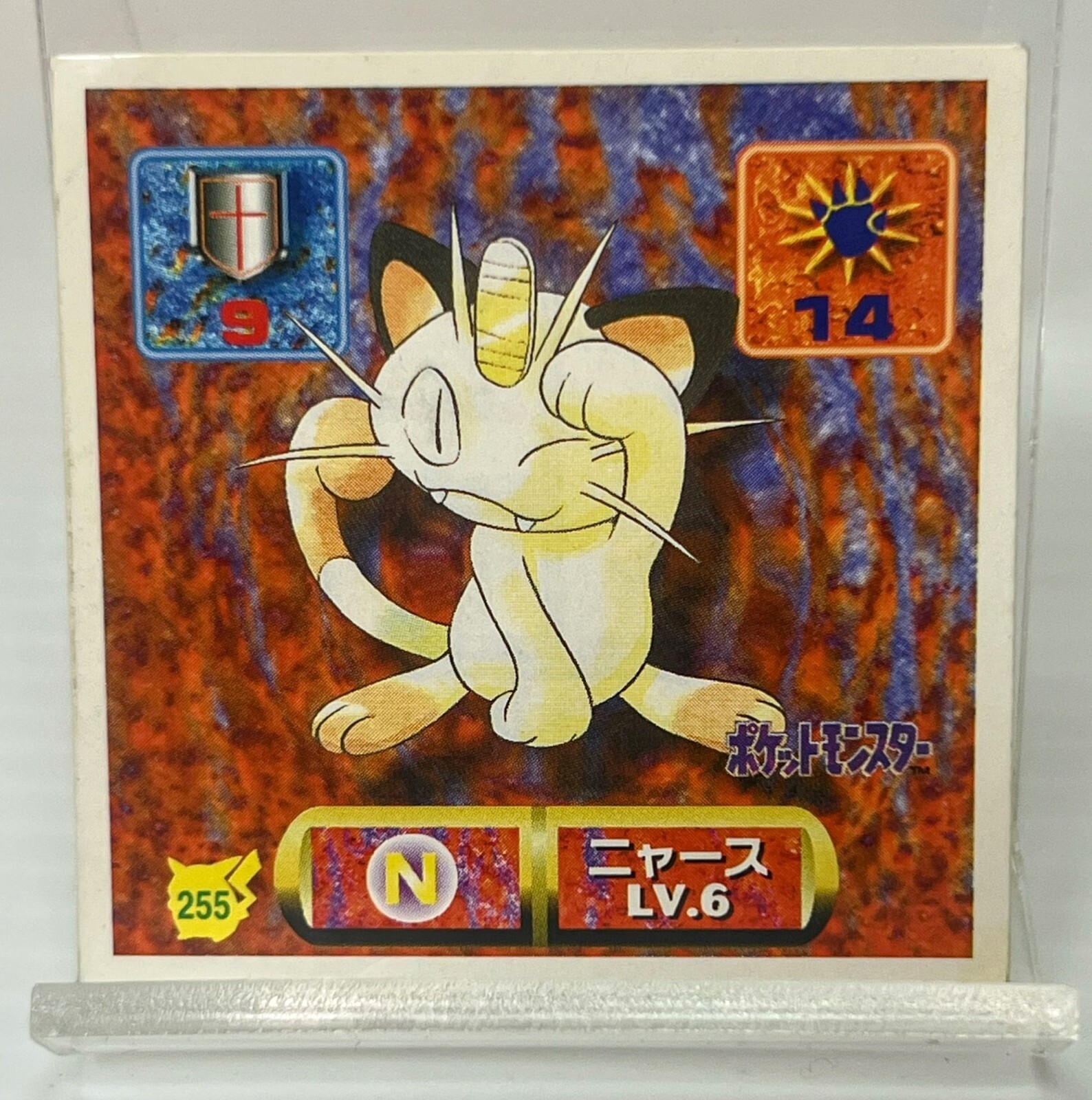
Meowth No.255: An Amada Pokemon Sticker from 1997

Meowth, Team Rocket’s Talking Cat
Meowth holds a distinctive place in the original Pokemon universe. As Pokemon No.52, this cat-type Normal Pokemon became a fixture of the anime from its earliest episodes — not as a trainer’s companion in the usual sense, but as the third member of Team Rocket’s trio alongside Jessie and James. What set Meowth apart from virtually every other Pokemon in the series was the ability to speak human language, a trait that made the character far more expressive and narratively prominent than most. From the anime’s first season, Meowth was one of the few Pokemon capable of carrying a scene through dialogue alone, giving the character an unusual presence across the entire original run.
This sticker depicts Meowth at Level 6, with the notation “Nyarth LV.6” worked into the design — Nyarth being the character’s Japanese name. The numbers 9 and 14 appear in the upper corners, likely representing in-game stat parameters, though their exact correspondence to specific stats is not confirmed by available documentation. The layout — an orange-and-blue speckled background, a shield icon at upper left, and a sun or paw icon at upper right — follows the visual template Amada used across its Pokemon sticker output during this period.
Amada and Japan’s Character Sticker Tradition
The manufacturer, Amada, was a Kanagawa-based company with a long history in licensed character goods. Since the 1970s and 1980s, the company had produced stickers, karuta card sets, and similar items tied to popular anime and tokusatsu properties — among them Kamen Rider, Dragon Ball, and Sailor Moon. By the 1990s, Amada had extended that work into video game and anime properties including Pokemon and Digimon.
Character stickers were already a defining format in Japanese children’s culture long before Pokemon arrived. In the 1980s, Lotte’s Bikkuriman stickers became a collecting phenomenon that reshaped how children engaged with cheap, serialized items. Individual stickers sold through dagashi-ya (small neighborhood candy shops), convenience stores, and toy retailers for just a few yen each, making them accessible to almost any child. When Pokemon accelerated through the mid-1990s, Amada was among several manufacturers — alongside Topolo, Media Factory, and others — who channeled that established sticker culture into the new franchise. Amada’s particular approach incorporated game stat figures directly into the sticker’s visual design, linking the physical item to the Game Boy experience in a way that resonated with children who knew Meowth’s in-game numbers as well as the anime storylines.
Made in 1997, Before the World Was Watching
The year 1997 was central to Pokemon’s Japanese expansion. The original Game Boy games — Pokemon Red and Green — had launched in February 1996. The anime series followed on April 1, 1997, airing on TV Tokyo, and the franchise began generating licensed merchandise across every conceivable format. This sticker, numbered No.255 within its series, was manufactured at the height of that domestic boom.
Pokemon would not reach North America or Europe until 1998 and 1999 respectively, which means items like this one were produced exclusively for the Japanese market. For collectors focused on Generation 1 history, that domestic-origin context carries weight: products from this window reflect the specific moment when Pokemon was still a Japanese cultural event rather than a global franchise. The serialized format — No.255 within a larger numbered set — also carried a deliberate collecting logic. Amada’s sticker lines were designed to encourage children to seek out every entry, a completionist structure built around numbered gaps. Decades later, that same design logic continues to appeal to collectors who track down the individual pieces that remain unaccounted for in their sets.

Shipped directly from Japan by a small shop
$8.15
Ships worldwide from Japan • Full photos and details on the listing