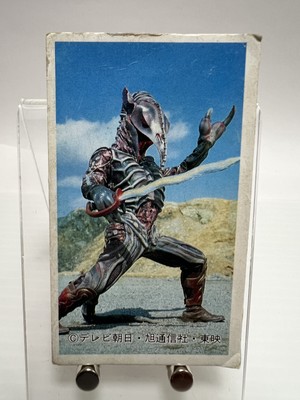
Gosei Sentai Dairanger Gorma Villain Menko Card (c. 1993–94)

What Is a Menko Card?
Menko are a distinctly Japanese form of playing card with roots stretching to the Edo period. Made from thick, stiff cardboard, they come in circular, rectangular, and other shapes. The game is simple: players slap cards onto a surface trying to flip their opponent’s cards over — whoever flips a card wins it. That mechanic made menko enormously popular among Japanese children through the postwar and high-growth decades of the 1950s and 1960s.
As anime and tokusatsu (live-action special effects) programming gained cultural footing, manufacturers began printing characters from popular series on the cards. This “character menko” sold cheaply at dagashiya — small neighborhood candy shops synonymous with Japanese childhood — and in toy aisles of supermarkets and department stores. By the early 1990s the card market was shifting toward trading card games, but a handful of makers kept character menko in production for long-running tokusatsu franchises. This card belongs to that later era of the form.
Dairanger and the Gorma Tribe
This menko carries an official copyright listing TV Asahi, Asahi Communications (now ADK), and Toei — the three rights-holders behind the Super Sentai franchise. Based on visual analysis, the depicted character appears to be a villain from Gosei Sentai Dairanger, the 17th Super Sentai series, which aired on TV Asahi from February 1993 to January 1994 across 50 episodes.
Dairanger’s enemy faction is the Gorma Tribe, whose monster designs draw on Chinese mythology and martial arts traditions. The character on this card shows dark segmented armor, reddish-brown accents across the chest and limbs, an elongated downward-curving snout, ear-like protrusions, and a curved white blade with a red handle. Visual comparison points toward a character known as Zyuuru — though that identification rests on imagery alone and should be treated as probable rather than confirmed without examining any text printed on the card itself.
One note on the listing’s “Showa Era” label: the Showa period ended in January 1989, and the series dates place this card in early Heisei Japan, circa 1993–94 — a minor but useful distinction for collectors building a precise catalogue.
Why Dairanger Resonates With International Collectors
Dairanger holds an unusual place in the global Super Sentai and Power Rangers community. When Saban Entertainment produced Mighty Morphin Power Rangers Season 2 in 1994, they incorporated Dairanger footage for Megazord sequences and monster battles while keeping the previous season’s American Ranger suits. Western audiences had no window into Dairanger at the time, giving the series a “hidden season” quality that continues to attract curiosity from fans who later discovered the source material.
The Gorma Tribe’s Chinese-influenced monster designs set Dairanger apart visually from other Super Sentai entries, drawing attention from collectors interested in tokusatsu character art. Menko were made exclusively for the domestic Japanese market with no formal international distribution, making them an uncommon category in overseas collections. The three-party official copyright on this card confirms it as a genuine licensed product — a verifiable detail that matters to collectors who value documentation alongside the object itself.

Shipped directly from Japan by a small shop
$7.86
Ships worldwide from Japan • Full photos and details on the listing