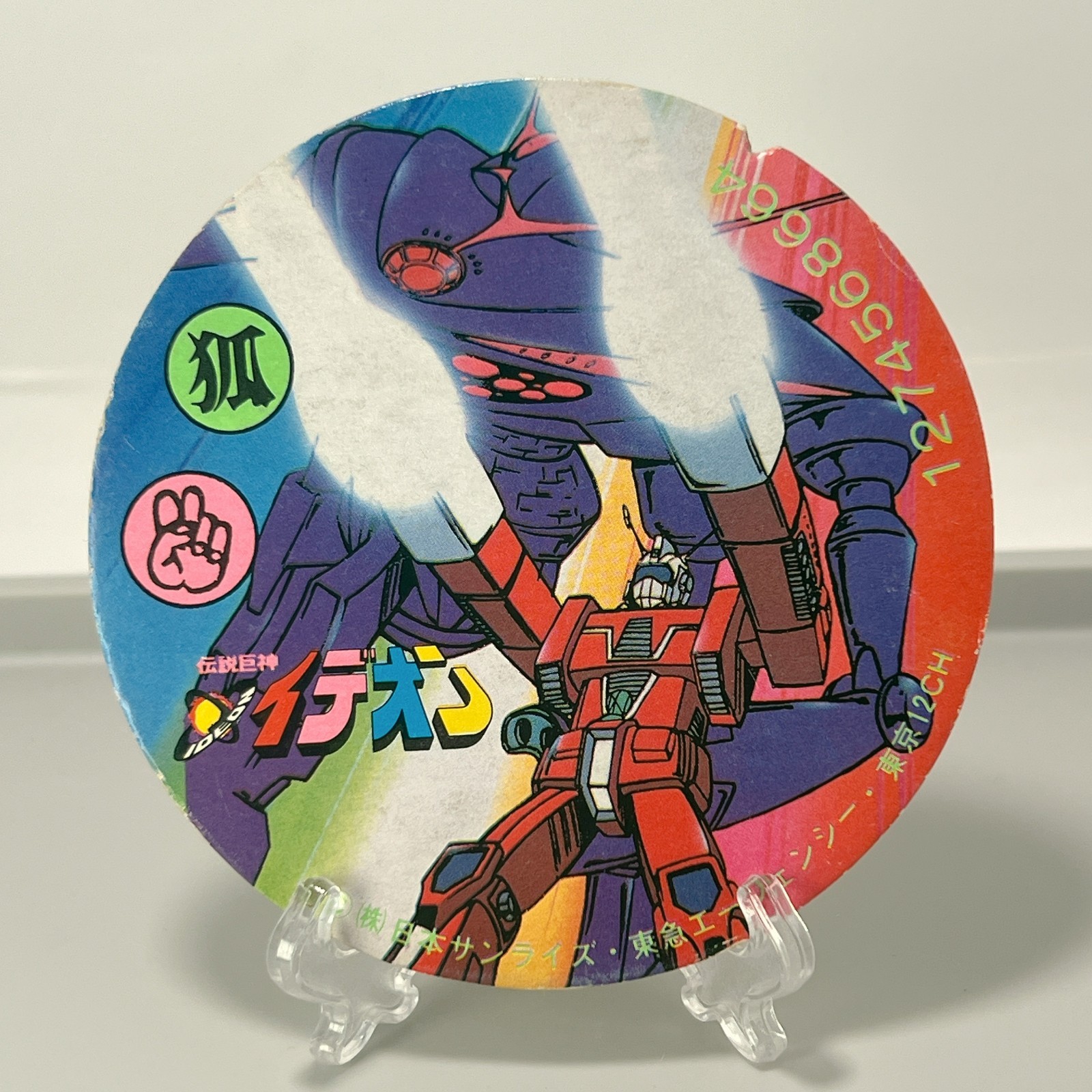
Space Runaway Ideon Round Menko Card, circa 1980

A Traditional Japanese Game Card From the Robot Anime Era
Menko are a traditional Japanese children’s game card, used in a playground game where the goal was to slam your card against an opponent’s card on the ground hard enough to flip it over or send it skidding away. Winners kept both cards. These cards were the currency of the dagashiya — the neighborhood candy-and-cheap-goods shop — sold loose or in small packs for pocket money.
This is a maru-menko, meaning it is circular rather than rectangular, a shape that became standard for character menko during the 1970s and early 1980s. Made from paper or thin cardboard, it was designed for active play rather than careful storage. The front shows Ideon, the red humanoid giant robot at the center of the series, facing off against what appears to be a large purple alien mecha from the Buff Clan — the enemy faction in the show. A hero-versus-villain face-off was the standard composition for character menko of the period.
Space Runaway Ideon: The Anime on the Card
Space Runaway Ideon — Densetsu Kyojin Ideon in Japanese — aired on Tokyo Channel 12 (now TV Tokyo) from May 1980 to January 1981 for 39 episodes, produced by Nippon Sunrise (now Sunrise, part of the Bandai Namco group). It followed directly in the lineup after Mobile Suit Gundam and aimed for the same serious science-fiction register.
The story centers on human colonists who discover three ancient alien vehicles on a distant planet. These combine to form Ideon, a massive robot powered by an energy force called the Ide — vast and ultimately uncontrollable. The crew of the Solo Ship is pursued relentlessly by the Buff Clan, an alien civilization whose organic-looking mecha use dark, predominantly purple color schemes. The series was cancelled before it could finish its story, but two theatrical films in 1982 completed the arc. The second, Be Invoked — known under that English title internationally — concludes with the deaths of nearly all the characters, a decision that made the film lastingly influential in the medium.
The director was Yoshiyuki Tomino, who also directed Gundam. In English-speaking anime circles, Tomino carries the nickname “Kill ‘Em All Tomino” for his willingness to kill principal characters — and Ideon is often cited as a prime example of that tendency taken to its furthest conclusion.
Broadcast-Era Licensing and What the Card Records
The card carries a “Tokyo 12CH” mark, confirming it was made during the show’s broadcast run. Credits on the card name Nippon Sunrise and Tokyu Agency, an advertising firm that managed sponsorship and licensing for TV Tokyo programming in this period. Both credits together strongly suggest a formally licensed product rather than an unlicensed copy. A circular green emblem — appearing to show the kanji for “fox” — is likely a manufacturer’s brand mark, though the specific printing company behind it has not been confirmed. A number string on the card is probably a lot or product management number, though this also remains unverified.
Because menko were designed to be played with — slapped against concrete, traded between kids, carried loose in pockets — paper examples from this era in good condition are uncommon. The format is largely unknown outside Japan, though Western collectors sometimes compare it to Pogs, the American milk-cap game from the 1990s. For collectors interested in the Sunrise studio catalog, early 1980s broadcast history, or Tomino’s filmography, a menko like this represents a direct physical artifact of how these shows existed in the world during their original run.


Shipped directly from Japan by a small shop
$9.75
Ships worldwide from Japan • Full photos and details on the listing