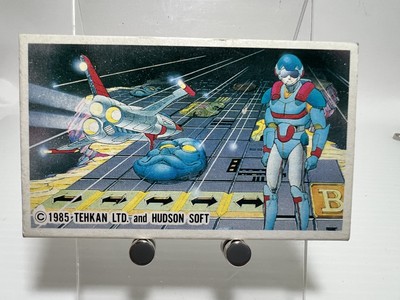
1985 Star Force Menko Card by Tehkan and Hudson Soft

What Is a Menko Card?
Long before trading cards became a global phenomenon, Japanese children were playing menko. Dating back to the Edo period, menko are thick cardboard cards used in a game where players slam their cards onto the ground, using the airflow and impact to flip an opponent’s card face-up — whoever flips wins what they flip. By the 1980s, the subject matter had shifted from traditional imagery to anime heroes, tokusatsu characters, and video game sprites, but the format and spirit of the game stayed unchanged.
Menko were sold at dagashiya — the small neighborhood candy-and-toy shops that served as a child’s first point of commerce — for a handful of yen apiece. They were made to be played with, not preserved. Designed as game pieces first and collectibles never, surviving examples from the 1980s tend to carry the marks of real use: worn edges, the evidence of games played on kitchen floors and school courtyards.
This particular card is an officially licensed product, confirmed by the copyright line © 1985 TEHKAN LTD. and HUDSON SOFT. The gold “B” printed in the lower right corner is consistent with the common menko practice of classifying cards within a set by series or grade — A, B, C, and so on — though the full composition of the set this card belonged to has not been confirmed from available records.
Star Force: Arcade Origins and the Famicom Moment
Star Force began life as a vertical-scrolling arcade shooter developed by Tehkan and released in 1984. Players controlled a sleek spacecraft called the Final Star, pushing through waves of enemy formations and taking on large boss encounters, among them Gordess — a blue, alien-form enemy that appears in the mid-to-late stages of the game. The card’s artwork also features a humanoid figure in blue-and-red science-fiction armor identified as Star Man, though sources differ on exactly where this character fits within the game’s structure.
Hudson Soft ported Star Force to the Famicom on August 2, 1985 — the same year this card was produced. The timing is almost certainly not coincidental. The Famicom version became one of the format’s early successes, and demand for paper merchandise tied to popular game characters surged alongside it. Hudson Soft later released the game for the NES in North America in 1987 under the same Star Force title, giving it a genuine international audience.
Two Companies, One Snapshot of Gaming History
What makes this card historically specific is the corporate names it carries. Tehkan Ltd., which had been developing arcade games since 1967, changed its name to Tecmo in 1986 — just one year after this card was printed. Official merchandise bearing the Tehkan name belongs to a narrow window of that company’s identity.
Hudson Soft has an equally defined endpoint. The Sapporo-based publisher — known also for Bomberman and Adventure Island — was absorbed into Konami in 2012 and ceased to exist as an independent company. Every licensed product carrying the Hudson Soft name is now, by definition, from a closed chapter.
For anyone familiar with the NES library or with the early Japanese arcade scene, Star Force sits at a recognizable intersection of both. This menko card, produced at the precise moment the Famicom version launched and bearing the imprints of both companies in the final or formative years of their original identities, functions as a small but legible document of where Japan’s video game industry and its street-level children’s culture briefly, completely overlapped.

Listed in our eBay store and sent from Japan
$7.86
International shipping available • Ask us anything before you buy