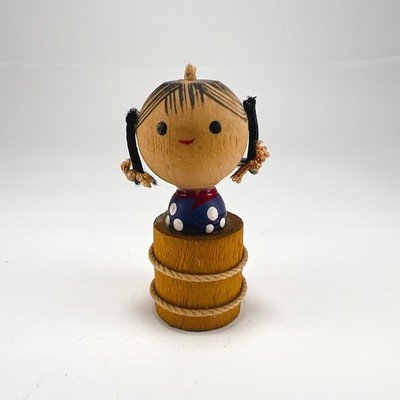
Mini Kokeshi Mascot Doll with Braids on a Barrel Base

A Mascot Kokeshi and How It Differs from the Traditional Kind
This small wooden figure follows the classic kokeshi form — a rounded head on a cylindrical body — while adding details that set it apart from strictly traditional work. The head carries painted black dot eyes, a small red mouth, and a black fringe, but physical braided cords are attached at either side to represent pigtails. The body is finished in blue with white polka dots and accented in red at the neck. Rather than standing on its own body the way most kokeshi do, this piece sits on a separate barrel-shaped base wrapped in natural fiber cord.
These choices place it in a recognized category within Japanese folk-craft circles: the mascot kokeshi. The blue-and-white polka dot coloring doesn’t correspond to any of the established regional styles — Naruko, Tsuchiyu, Togatta, and the others each have strict conventions governing shape, color, and motif — and the barrel base is an addition you wouldn’t find in traditional lineage work. What you have instead is a freely designed piece built around visual appeal and portability, the kind of doll that found its home in the souvenir shops of hot spring towns, airports, and temple gates across Japan.
From Edo-Period Woodturners to the Tourist Souvenir Market
The kokeshi form is generally traced to the late Edo period, roughly the late 18th to early 19th century, when woodturners in the Tohoku region’s hot spring resort towns carved simple dolls during the agricultural off-season. Originally made as children’s toys for families visiting the baths, kokeshi gradually became a recognized folk-craft category. By the mid-20th century, traditional kokeshi had developed into a serious collecting field — certain lineages are now officially designated traditional crafts by Japan’s Ministry of Economy, Trade and Industry — while a parallel stream of creative kokeshi emerged in the 1950s as artists brought individual expression to the form.
The mascot kokeshi grew out of Japan’s postwar economic boom, as expanding domestic tourism created demand for small, affordable, and visually accessible keepsakes. Pieces like this one became fixtures in souvenir markets nationwide. The exact production date and maker of this particular doll can’t be confirmed from the available information — only a broad postwar-and-beyond window applies — but the style is characteristic of the type that has been circulating since the high-growth era of the 1960s onward.
Why Kokeshi Draw Interest from Collectors Around the World
Among Japanese folk crafts, kokeshi hold an unusual place internationally. The word KOKESHI itself has entered mainstream recognition among Japanese culture enthusiasts abroad in a way that few other folk-art terms have, partly because the simplified, nearly abstract human form translates across cultural contexts with ease.
A piece like this one offers things that collectors find genuinely distinctive. It’s handmade wood rather than molded plastic, which means it carries the slight variations that come with hand craft — no two are exactly alike. The combination of physical braids, polka dot body, and wrapped barrel base creates a layered visual identity within the mascot category. And because it’s not tied to any commercial IP or franchise, it represents Japanese aesthetic sensibility on its own terms: an artifact of craft culture rather than a tie-in product.


Comes straight from Japan — no middleman
$17.93
Ships internationally • More photos on the eBay listing